When Hair Transplant Shock Loss Starts and When It Ends?
Written by Perseus Editorial Team
Last Update: November, 2026
Medical Disclaimer:
This is an educational article, not medical advice. Every transplant, scalp and clinic protocol is different, and nothing here can be guaranteed to work for you. The suggestions below are general ideas only. Before you try any of them, talk to your post-op team and follow their instructions first. If anything in this article conflicts with what your surgeon or clinic told you, follow your clinic.
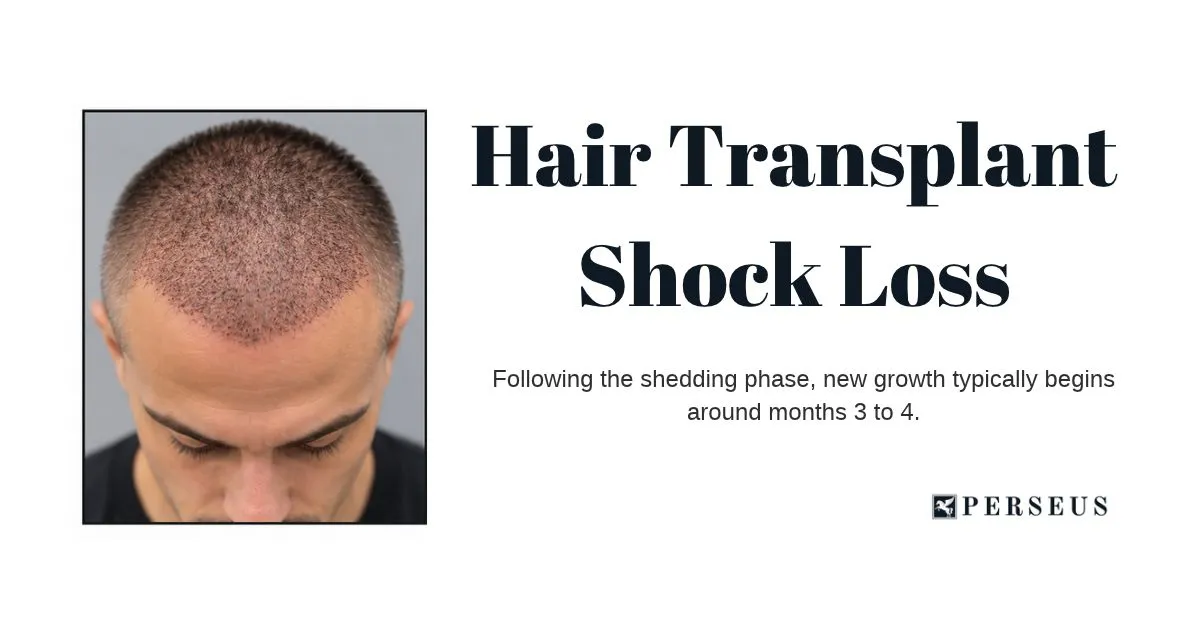
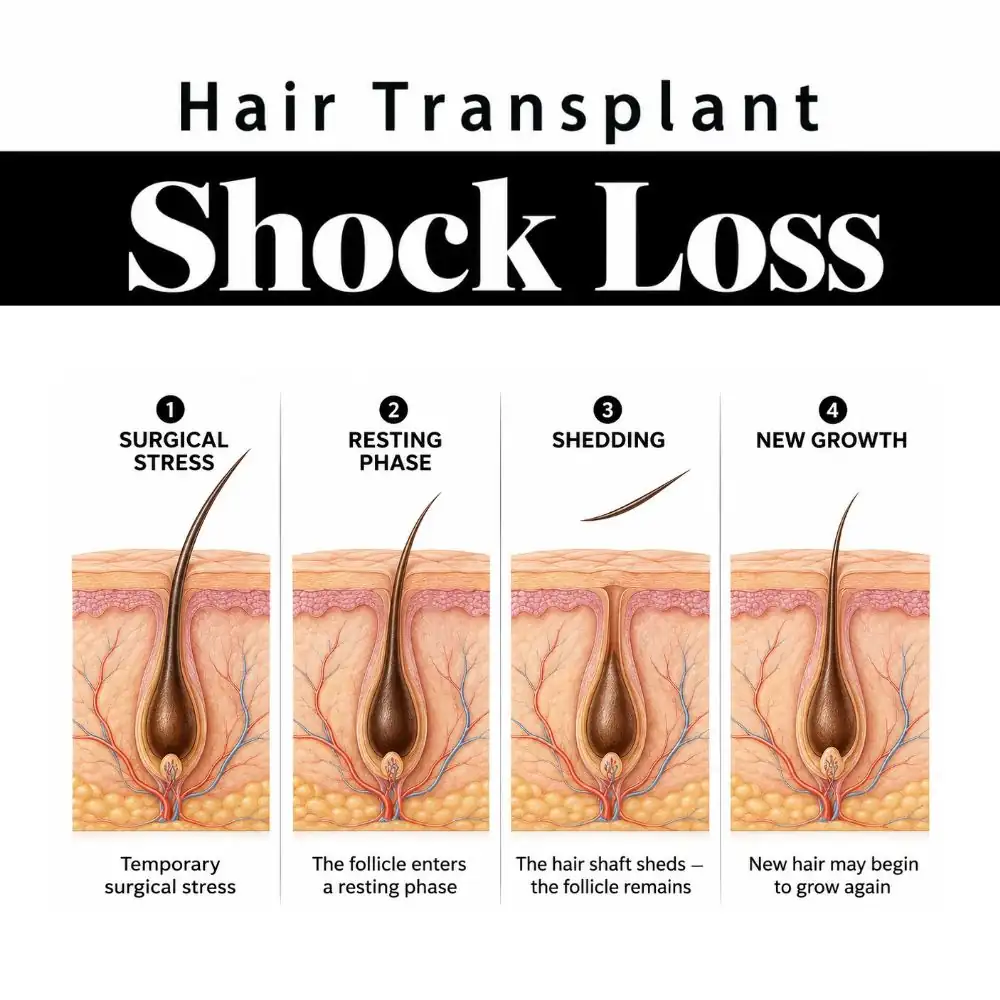
Three weeks after your op, the transplanted hair starts falling out. In general, this is the most distressing moment of the entire process because it can look exactly like something has gone wrong. That’s exactly what hair transplant shock loss is, and your surgeon expects it to happen. The hair shaft sheds, but the follicle remains intact. A few months later, that same follicle starts producing new hair.
What is hair transplant shock loss?
At the end of the day, a hair transplant is still an injury. Making thousands of tiny incisions in the scalp puts stress on the follicles in that area. As a result, some follicles cut their growth phase short and enter a resting phase. The hair shaft then sheds, but the follicle stays in the skin and eventually starts growing hair again.
The same thing can happen after an illness or a stressful period. This type of shedding is known as telogen effluvium. When surgery triggers it, it’s called post-operative effluvium.
- Transplanted hair sheds. The hair that comes attached to your grafts will fall out during the first few weeks. This can happen to any patient.
- Existing hair can shed too. The hair around the transplanted area may also be affected by the stress of the surgery and may fall out more.
Does everyone get hair transplant shock loss?
For the transplanted hair, close to everyone. The hairs that came with your grafts are going to fall out, and your surgeon expects it. Some patients don’t even notice because their hair was cut short for surgery and the tiny shed hairs are so light, which is why you’ll find forum posts from people insisting it never happened to them. It did. They just didn’t see it.
How common is shock loss after a hair transplant?
Let’s look at what the research tells us.
A 2024 study published in Aesthetic Plastic Surgery examined 621 hair transplant patients and found that 23 experienced temporary hair shedding in the recipient area (recipient-site effluvium).
- Male patients: 9 out of 554 experienced shock loss (approximately 1.6%).
- Female patients: 14 out of 67 experienced shock loss (approximately 20.9%).
The findings suggest that women may be considerably more likely to experience shock loss after a hair transplant. However, the study involved a relatively small number of female patients, so these figures should not be taken as universal rates for all hair transplant patients (Okochi et al., 2024).
When does shock loss start, and how long does it last?
The shedding isn’t random. It runs on a schedule, and knowing the schedule is most of what calms people down.
Timing | What happens |
Week 1 to 2 | Crusts lift off. Some hairs come away with them. |
Week 2 to 6 | The main shedding window. Heaviest for most people in weeks 3 and 4. |
Week 6 to 12 | The low point. Many patients look thinner than they did before surgery. |
Month 3 to 4 | New hairs push through. Fine, pale and easy to miss at first. |
Month 6 | Roughly half of the final density is usually visible. |
Month 12 to 18 | Final result. Thickness and texture settle last. |
Each stage has its own guide with patient photos: month 1, month 2, month 3, and the full recovery timeline.
Between month two and month four the scalp often looks worse than it did the day before surgery. Surgeons call this the ugly duckling phase. It is the part nobody warns patients about properly, and it is also the part that ends on its own.
One detail that helps: the new hairs do not all arrive together. They come through in waves over several months, which is why the regrowth looks patchy long before it looks even.
Does shock loss affect your existing hair?
It’s normal for the grafts to shed.
What’s surprising is that you lose your own hair as well. When a surgeon puts grafts between your existing hairs, those hairs are placed inside the surgical field. The blood supply in the area changes for a few weeks, and the weak follicles go into rest along with the transplanted ones. The thinner and smaller a hair is, the more likely it is to fall out (Romera de Blas et al., 2026).
You are more likely to see this if:
- You had thinning hair in the recipient area rather than bare scalp. Bald skin has nothing left to shed.
- The grafts were packed densely between your existing hairs.
- You are a woman with diffuse thinning. Female pattern loss usually means grafts go in among existing hair instead of into empty scalp.
- Less often, the donor area sheds too.
Native hair that sheds this way usually comes back within three to six months.
Is what you are seeing normal?
Normal
- Shedding due to hair transplant shock loss that starts somewhere between week two and week four
- Short hairs with a small white bulb on the end. That bulb is the keratin sheath, not your follicle. The follicle is microscopic and it is still in your scalp.
- Looking thinner at week eight than you did at week one
- Shedding that slows down and stops around month three
- Patchy, uneven regrowth as the follicles restart at different rates
Worth a call to your clinic
- You are still shedding heavily at month five. By then it should have stopped.
- The shedding stopped, but month six comes and nothing has grown back.
- Your scalp is red and hot, there is pus, or it hurts to touch. Call the same day. This is infection territory and infection does not wait.
- In the first ten days, a hair comes away with a bead of blood or leaves a small pit behind. That is a graft, not a shed hair.
- A patch where the skin underneath looks scaly or oddly shiny. That one is a dermatologist’s job rather than your surgeon’s.
What helps and what does not?
Since hair transplant shock loss is a normal occurrence, there is no need for a treatment to prevent it. This is related to the follicles’ reaction to the surgery, and there is no hair care product on the market that can completely stop this process. What you can do is prevent the situation from getting worse and take proper care of your natural hair.
Worth doing
- Handle your scalp gently. No rubbing, no scratching, no picking at crusts. These are among the most common post-transplant mistakes.
- Keep taking whatever your surgeon prescribed, for as long as they said.
- Ask for a ferritin, vitamin D and zinc panel if you have not had one. A deficiency will not cause shock loss and correcting it will not stop it, but low iron does slow the regrowth you are waiting for.
- Resist comparing your scalp to other people’s month three photos. Regrowth runs on a wider range than the forums suggest.
- Photograph your scalp every two weeks, same spot, same light. Regrowth is invisible day to day and obvious month to month. This single habit saves more patients from panicking than anything else.
Ask your surgeon first
- Minoxidil. Some surgeons prescribe it around the time of surgery to shorten the shedding phase and protect native hair. The evidence is mixed and it does not suit everyone. Starting it on your own also triggers its own shedding phase, which muddles the picture at exactly the wrong time.
You can read the article prepared by our editors on the use of minoxidil after hair transplantation.
- Finasteride. For male pattern loss it protects your existing hair from further miniaturisation. It does nothing for transplanted hair shedding, and it is prescription only.
You can learn about ways to reduce hair loss with finasteride in this article.
Not worth doing
- Switching shampoos or starting new products in a panic at week three
- Massaging or stimulating the area to wake the follicles up
- Buying anything sold as a shock loss cure. There is no such product.
Post-transplant care sets do not prevent shock loss, and anyone telling you otherwise is selling something. What they are for is keeping the scalp clean and calm while the follicles restart.
FAQs About Hair Transplant Shock Loss
How long does shock loss last after a hair transplant?
Shock loss usually starts between weeks two and eight after your op, and the shedding can continue for several weeks. Once the affected follicles leave their resting phase, new hair starts to grow, usually around month three. At first, the new hairs may be fine and hard to notice, but you’ll gradually see more growth over the following months.
Will the transplanted hair grow back?
In almost all cases, yes. Grafts that survived the first ten days are anchored, and an anchored graft grows.
Can shock loss be permanent?
Transplanted hair comes back. Native hair that was already heavily miniaturised sometimes does not. This is uncommon and it is more likely in people who had significant thinning in the recipient area before surgery.
Why are women more vulnerable to shock loss?
Women with female pattern hair loss (FPHL) may be more vulnerable to shock loss because their hair follicles are already miniaturized and potentially more sensitive to surgical trauma. Additionally, hair transplantation in women often involves placing grafts between existing hairs, which can expose surrounding native follicles to temporary stress.
A 2024 study published in Aesthetic Plastic Surgery also found a significantly higher rate of shock loss in women, particularly those over 40 with FPHL. However, since only 67 women were included, the findings should be interpreted with caution.
Is shock loss worse with DHI or FUE?
Both techniques cause it. What matters more is how much existing hair was in the recipient area and how densely the grafts were placed.
Can I lose hair in the donor area?
Yes, although it’s less common than shock loss in the recipient area. The donor area can also experience temporary shedding, known as donor-site effluvium. It happens when the surgical trauma, inflammation, or temporary changes in blood supply around the extraction sites disrupt the growth cycle of nearby hairs.
This usually starts around two to four weeks after your op and resolves within three to six months as the affected follicles resume growing. However, not all donor area thinning is temporary. If too many grafts are removed from the same area, it can lead to overharvesting, leaving permanent gaps or visibly reduced density.
Should I start minoxidil during shock loss?
Only if your surgeon tells you to. Minoxidil has a shedding phase of its own when you start it, so beginning it in the middle of shock loss makes it harder to tell what is going on.
References
- Romera de Blas C, Vega Díez D, Ricart Vayá JM, Gómez Zubiaur A. Complications in follicular unit excision hair transplantation: current evidence and practical approaches. Front Med (Lausanne). 2026;13:1750989. Published 2026 Feb 3. doi:10.3389/fmed.2026.1750989
- Kerure AS, Patwardhan N. Complications in hair transplantation. J Cutan Aesthet Surg. 2018;11(4):182-189. doi:10.4103/JCAS.JCAS_125_18
- Garg AK, Garg S. Complications of hair transplant procedures—causes and management. Indian J Plast Surg. 2021;54(4):477-482. doi:10.1055/s-0041-1739255
- Liu RH, Xu LJ, McCarty JC, Xiao R, Chen JX, Lee LN. A scoping review on complications in modern hair transplantation: more than just splitting hairs. Aesthet Plast Surg. 2025;49(3):585-595. doi:10.1007/s00266-024-04316-3
- Leavitt M, Perez-Meza D, Rao NA, Barusco M, Kaufman KD, Ziering C. Effects of finasteride (1 mg) on hair transplant. Dermatol Surg. 2005;31(10):1268-1276. doi:10.1111/j.1524-4725.2005.31202
- Okochi H, Onda M, Momosawa A, Okochi M. An analysis of risk factors of recipient site temporary effluvium after follicular unit excision: a single-center retrospective study. Aesthetic Plast Surg. 2024;48(7):1258-1263. doi:10.1007/s00266-023-03699-z.
Recommended Reading
✦ Hair Transplant Necrosis: Learn about the causes, early warning signs, and prevention of tissue necrosis after a hair transplant procedure.
✦ Menopause Hair Loss: Discover how hormonal shifts during menopause affect hair thinning, along with effective management and care tips.
✦ Scalp Buildup: Causes, Signs & Removal: Understand what causes residue accumulation on the scalp, how to spot the signs, and the best ways to keep your scalp clean and healthy.


Receive offers, product alerts, styling inspiration and more. By signing up, you agree to our Privacy Policy.
- info@perseusstyle.com