hair transplant necrosis: causes & treatments
Written by Perseus Editorial Team
Last Update: August, 2026
FUE hair transplantation, the most popular, low-risk and modern hair restoration technique, carries a small risk of hair transplant necrosis – tissue death. In this blog post, we will discuss the causes, risks, and management of hair transplant necrosis. Necrosis after hair transplantation usually occurs in the 1st month of hair transplant. The risk of necrosis in FUE hair transplantation is usually less than 0.5% and if it occurs, it can be partially compensated by a hair transplant under appropriate conditions after the damaged area has healed. However, with early intervention, it is also possible to solve the problem without the need for hair implantation again. And here are the details…
What Exactly Is Hair Transplant Necrosis?
The death of scalp tissue due to poor blood flow is a rare but serious complication of Giant Cell Arteritis (GCA). This is a condition that causes inflammation in blood vessels. In turn, this leads to the death of tissue in a localised area. In cases like this, patients will have pain in their scalp and long-term red skin lesion in the area where the ophthalmic branch of the trigeminal nerve is. This nerve sends sensations to the forehead and upper part of the face.
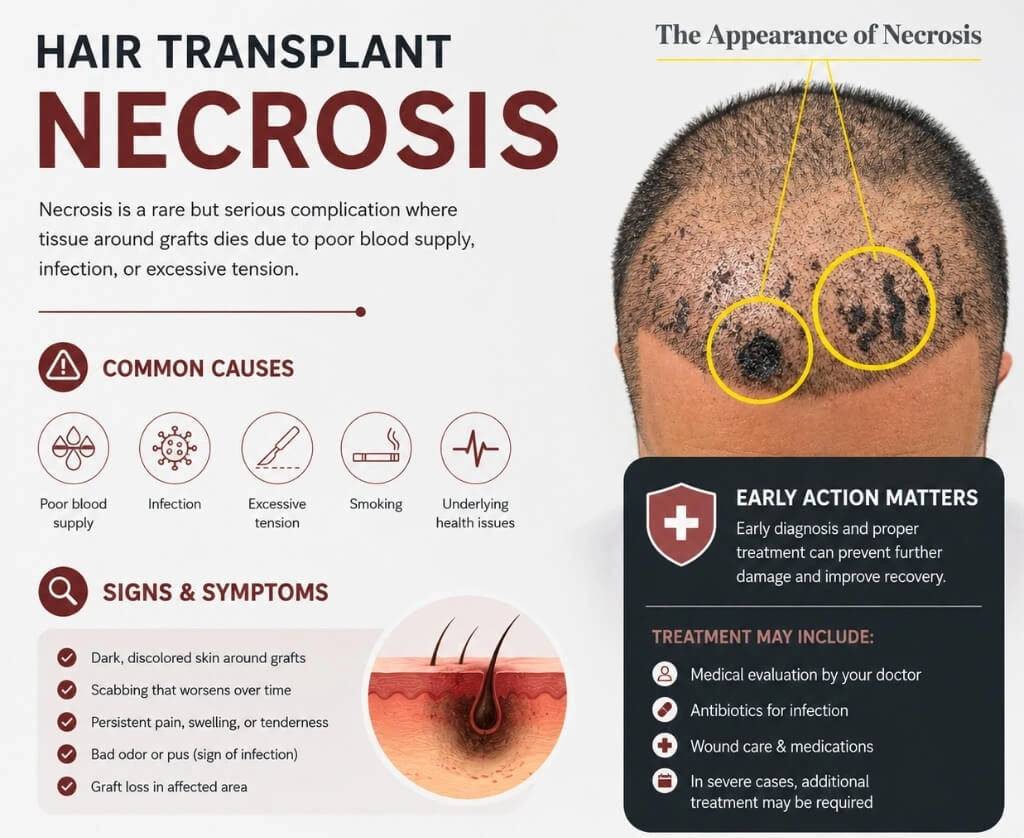
Most of the time, you can see signs of dead tissue in the donor or recipient area within the first 1 to 3 weeks. These signs include ongoing redness, dark colouring, or crusting that doesn’t follow the usual healing timeline.
What causes necrosis after hair transplantation?
The main problem is that there is not enough blood. Here are the most common causes of hair transplant necrosis: Excessive trauma due to over-harvesting grafts, tight closure and suturing, dense packing of grafts, and anesthesia complications. Hair transplant necrosis commonly occurs due to the old type of hair transplantation, FUT. This is because FUT involves making strip incisions, which sometimes leads to vascular strangulation and collapse around the edge of the wound.
Who is more likely to experience hair transplant-related necrosis?
Though hair transplant necrosis can affect any patient, certain factors increase the likelihood.
- Heavy smoking and nicotine use can cause reduced scalp perfusion.
- Microvascular compromise in diabetic patients (diabetes mellitus) raises the risk of hair transplant necrosis.
- Previously compromised tissue, which may be the result of scalp scarring or previous procedures, is more susceptible to ischaemia.
- Localised infections can disrupt healthy wound healing and result in tissue death.
- Epinephrine constricts blood vessels, and excessive use can prolong ischaemia.
Signs to watch out for: How to spot scalp necrosis early
Early detection of scalp & hair transplant necrosis can improve patient outcomes. Below are the symptoms that warrant immediate medical care:
- Severe pain, regardless of the size of the wound.
- A wound accompanied by a fever (higher than 38°C) and a rapid heartbeat (more than 100 beats per minute).
- Persistent dark red or black lesions.
- Delayed healing: Wounds that fail to epithelialise within the expected timeframe.
- Greyish foul odour or discharge.
- Skin blisters
- A small sore or pus-filled bump that is unusually painful to the touch.
What are the risk factors for post-op necrosis?
| Risk Factor | Why It Increases Risk | Risk Level |
|---|---|---|
| Smoking & Nicotine66.7% of necrosis cases | Constricts blood vessels and reduces scalp perfusion, starving tissue of oxygen during the critical healing window. | High |
| Diabetes Mellitus | Microvascular compromise impairs capillary blood flow, slowing oxygenation and wound healing at the follicle level. | High |
| Dense Graft Packing | Placing grafts too closely compresses the vascular network between incisions, cutting off blood supply to surrounding tissue. | High |
| Previous Scalp Surgery | Scar tissue has reduced vascularity and is more susceptible to ischaemia under surgical stress. | Moderate |
| Excessive Epinephrine | Prolonged vasoconstriction from high doses can deprive tissue of blood supply beyond the intended anaesthetic window. | Moderate |
| Over-Harvesting (FUE) | Excessive punch extractions damage the vascular network in the donor area that causing localised tissue death at harvest sites. | Moderate |
| High-Tension Closure (FUT) | Closing the donor strip under excess tension causes vascular strangulation at wound edges, triggering necrosis in adjacent tissue. | Moderate |
| Localised Infection | Pre-existing / post-operative infection introduces bacteria that disrupt normal wound healing and accelerate tissue breakdown. | Lower |

Is it possible to stop it? Yes, here is how.
Following good clinical practices can reduce the risk of this. Doctors should:
- Check that patients are suitable for surgery before the op. This is especially important for people with uncontrolled diabetes or who smoke a lot.
- Use blunt needles and handle grafts carefully to protect the tiny blood vessels.
- Don’t graft too densely, as this can block blood flow.
- Make all substances weaker by diluting them properly, and be careful when you apply them.
- Hydration and nutrition are really important for the skin to heal well.
What can patients do?
- Make sure you drink enough water and eat well after the op.
- Try not to smoke or drink alcohol, as these can affect the duration of healing.
- Follow all the instructions you are given after your operation. This includes how to care for your wound and which medicines you must take.
Treatment options for dead skin on the scalp?
Doctors use special products like antiseptic solutions & creams to gently remove dead skin cells and help the area heal. If there’s a risk of infection, they might give you antibiotics. On the other hand, for bigger wounds, a medical device can help. However, in serious cases, doctors remove the damaged tissue and cover the area with healthy skin from another part of the body.
What should you do if you notice necrosis after your surgery?
Don’t wait in vain. Let your clinic know as soon as you spot any symptoms, like black skin or delayed healing. Don’t remove the scabs or apply random creams. It’s not OK to treat yourself when you’re in such a serious condition. These actions can make the condition worse.
Will necrotic tissue fall off?
In cases of superficial necrosis, the tissue death is minor and limited to the top layer of the skin. It will eventually dry out, turn into a dark crust, and lift away after 3 to 6 weeks. However, deep vascular necrosis is far more severe. With vascular necrosis, the tissue death goes much deeper; the resulting hard, black eschar will eventually separate at the edges as the body attempts to reject it, but this process takes much longer and leaves a deep wound. Please be aware that necrosis is entirely different from normal post-op crusts. It is a rare and serious complication that must be treated immediately by a doctor.
Healing from hair transplant necrosis after FUE
It can take a long time to heal and how long it takes depends on how badly the tissue has been damaged:
- Little black spots on the skin should get better over the next 3 to 6 weeks with gentle treatment.
- Larger areas might take months and you might need more operations.
- Hair may not grow back in areas of hair transplant necrosis. Treatments like SMP (scalp micropigmentation) or secondary hair transplants might be an option.
- One of the causes of hair transplant necrosis is the use of regular shampoo. Intense chemicals irritate the skin and prepare the ground for infection. After your doctor has started hair transplant necrosis treatment, you can safely use Perseus Post-Hair Transplant Shampoo with his approval.
FAQs about Hair Transplant Necrosis
Is it normal to have dead skin after a hair transplant?
Yes, it is normal to see some dead skin / scabbing / crusting after a hair transplant, particularly in the initial week. These small crusts form around the bald and donor areas as part of healing process. In fact, scabs are a good sign. They show that your body is making clots to protect the small cuts from getting infected. As the skin on the scalp heals, the scabs will gradually fall off. However, noticing necrosis with pain that not go away, that’s a sign something’s wrong.
What does early stage hair transplant necrosis look like?
At first, it looks like a normal skin infection, like cellulitis. The affected area may look pale, then quickly turn red or maybe bronze. The skin feels warm, swollen, and very tender or hurts. As it gets worse, the skin may go a dark purple colour and get big blisters full of fluid.
How do I know if I damaged my hair transplant?
There are a few signs that something might be damaged:
- Some people have experienced things like grafts falling out or bleeding in the first few days.
- Swelling, redness or pain that is more than normal.
- Don’t pick scabs too soon.
- You won’t have to worry about shedding or regrowth after a few months.
- Signs that there is an infection include pus, a bad smell or a fever.
If you notice any of these, contact your surgeon straight away.
Will hair transplant necrosis heal on its own?
No, necrosis won’t heal on its own. If you have dead tissue, you need to get a medical professional to treat and remove it. This stops the infection and helps the healing.
How long after surgery does hair transplant necrosis start?
Necrosis can begin within the first few days after an operation, normally between 2 to 5 days, as blood flow becomes blocked in the affected area. Changes in texture, such as it being firmer or having a leathery feel, often show that there is necrotic tissue beneath the surface. Necrosis can occur within 2 days after surgery or at any time during the first one to one and a half months.
How quickly can hair transplant necrosis spread?
Hair transplant necrosis can spread quickly — sometimes within hours — especially if there is an infection. These bacteria reproduce quickly, so the infected area can get bigger very quickly. While this can vary from patient to patient, a large open wound can form within just two days of the onset of symptoms.
Citations
- Khalid N, Azimpouran M. Necrosis Pathology. In: StatPearls. StatPearls Publishing, Treasure Island (FL); 2025. PMID: 32491559. Access from Europe PMC
- Golstein P, Kroemer G, Cell death by necrosis: towards a molecular definition, Trends in Biochemical Sciences, 32, 37-43
- J Currey, Scalp necrosis in giant cell arteritis and review of the literature., British Journal of Rheumatology, Volume 36, Issue 7, Jul 1997, Pages 814–816, https://doi.org/10.1093/rheumatology/36.7.814
- Chen J, Qu Q, Guo Y, et al. Recipient site scalp necrosis: A rare postoperative complication of hair transplantation. J Cosmet Dermatol. 2024;23:622-629. doi:10.1111/jocd.16017
Recommended Reading
✦ Follicle Vitality: Hidden Iron Deficiency Signs — The relationship between oxygen flow and follicle vitality is often overlooked. Monitoring ferritin levels clarifies hair strength loss.
✦ Scalp Health: Side Effects on Scalp Health — Pharmaceutical interactions can disrupt growth phases. Identifying triggers helps in preserving hair density.
✦ Modern Aesthetics: Behind the Red Carpet Looks — High-profile hair restorations set the standard for modern aesthetics and the potential of advanced hair science.


Receive offers, product alerts, styling inspiration and more. By signing up, you agree to our Privacy Policy.
- info@perseusstyle.com