How Much Hair Loss Is Normal? Daily Shedding & Post-Transplant Guide
Written by Perseus Editorial Team
Last Update: October, 2026
Medical Disclaimer: The information and product care insights shared here are for educational purposes only. Post-surgical care routines must align strictly with your operating clinic’s protocols. Never alter, start, or discontinue any topical treatment or supplement protocol without explicit clearance from your hair restoration surgeon.
Based on your own experience, how much hair loss do you consider normal? It’s natural to find hair on your pillow, in the shower drain, or on your brush. However, if the number of strands is gradually increasing, this may be a cause for concern. Especially after a hair transplant, hair loss, even though it’s exactly what’s supposed to happen, can still be concerning.
In the text below, after providing a numerical answer to how much hair loss is normal, you’ll find information on how to distinguish temporary hair loss from actual hair loss, as well as how much hair loss to expect each month following a hair transplant.👇
Key Information in This Article
- For most people, losing approximately 50 to 100 strands of hair per day is considered normal.
- Hair loss is temporary and spreads evenly. True hair loss manifests as thinning in specific areas or a gradual decrease in density.
- Typically, in male-pattern hair loss, thinning is most pronounced at the crown and on the sides, whereas in female-pattern hair loss, there is general thinning across the scalp.
- Most increases in hair loss have a temporary cause, such as illness, stress, or nutritional deficiency, and the condition usually resolves within a few months.
- Sudden clumps of hair loss, bald patches, or persistent hair loss are valid reasons to see a doctor.
How Much Hair Loss Is Normal Per Day?
The American Academy of Dermatology’s statement that losing approximately 50 to 100 strands of hair per day is normal is information you can find on many sources online. Some experts set this range a bit wider. Although it may sound like a lot, the average person has approximately 100,000 or more hair follicles on their scalp (Healthline); therefore, losing 100 strands of hair will hardly change the appearance of your hair at all.
The number you see depends on more than the count:
- Wash days: washing collects hairs that had already detached.
- Hair length: shedding is more noticeable on longer hair, in the shower drain and on brushes.
- Brushing: a brush mostly collects hairs that have already fallen from their follicles that day.
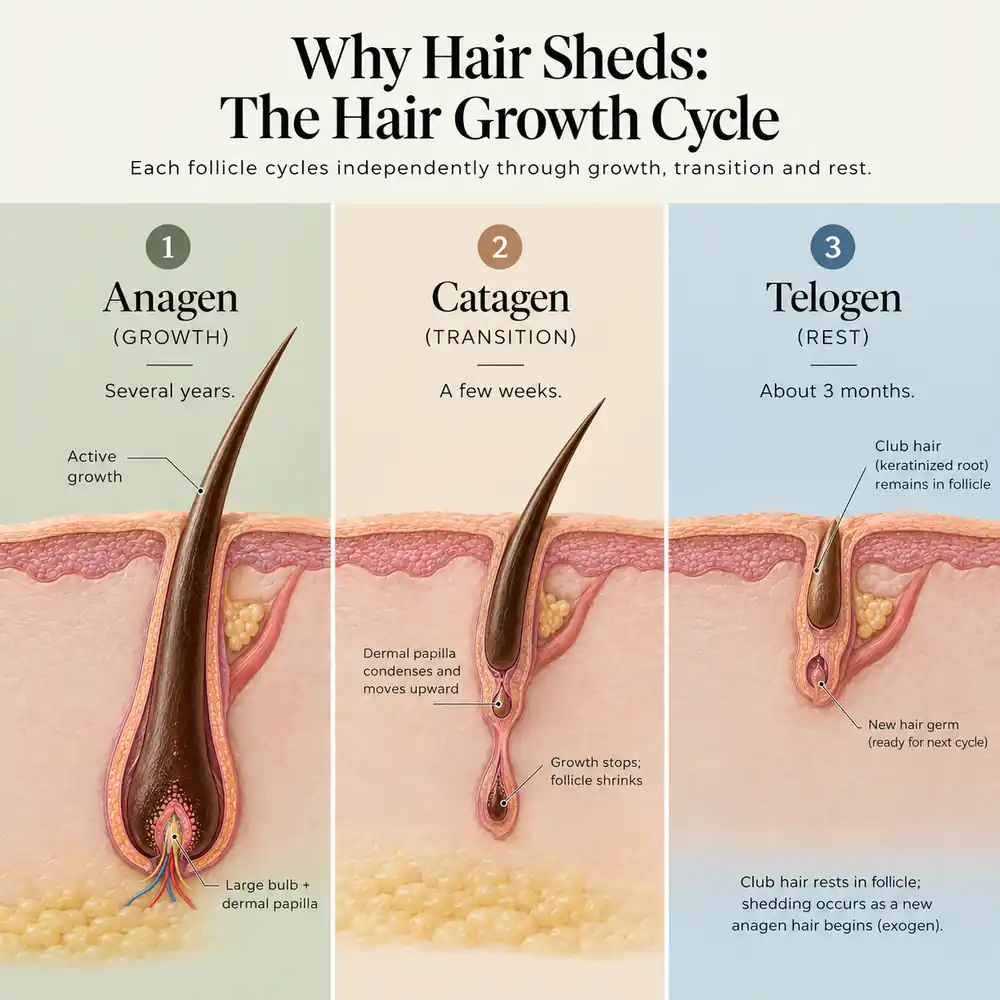
Why Hair Sheds?
Each follicle follows its own unique cycle and goes through 3 stages:
- Anagen (hair growth): lasts several years.
- Catagen (transition): a short stage lasting several weeks.
- Telogen (resting): lasts about three months and ends when the old hair falls out to make way for new hair.
Why the Transition Phase Triggers Shedding?
Shedding starts when growth gives way to rest, and each follicle operates according to its own schedule. In catagen, cell division stops and the lower follicle shrinks, pulling away from the dermal papilla, the small structure that supplies it with blood and nutrients.
Without that supply, the hair turns into a club hair. It moves up toward the scalp surface and enters telogen. Until a new hair grows in underneath and pushes it out, it remains there loosely.
A big physical shock can throw this off. Surgery, an injury or a sudden illness can push growing follicles into rest early. If enough of them switch at the same time, you may notice a wave of shedding a few weeks later.
What Causes More Shedding Than Normal?
When hair loss goes above your usual level significantly, there is usually an unforeseen cause behind it. The medical term for this condition is telogen effluvium. It typically appears about 2 to 3 months after the triggering event, which makes it difficult to identify the cause.
Common causes are:
- Illness, high fever, or surgery
- Major emotional or physical stress
- Biological changes, such as the months after childbirth
- Insufficient iron, vitamin D, or protein, or a thyroid problem
- Rapid weight loss or crash dieting, such as extreme keto or liquid-only cleanses
- Certain medications, such as blood thinners, retinoids, or beta-blockers
- Tight hairstyles, like slicked-back high ponytails or tight braids, and heavy heat styling
After the trigger has passed, most cases resolve in a few months. It’s worth getting evaluated if shedding persists for more than six months. See our guide to hair loss after COVID for a more detailed examination of viral infection as a trigger.
Hair Shedding vs. Hair Loss: What Is the Difference?
| Hair shedding | Hair loss | |
|---|---|---|
| Where | Spread evenly across the scalp | Specific areas: hairline, temples, crown, part |
| Time course | Weeks to months, then settles | Gradual and ongoing |
| Density | Returns to normal | Slowly decreases |
| Typical triggers | Illness, stress, hormones, diet | Genetics, hormones, scarring conditions |
Signs that indicate real hair loss include a receding hairline, a widening part, a thinner ponytail, or areas where the hair no longer fills out. Daily hair shedding is usually temporary. In contrast, genetic hair loss tends to progress if left untreated.
One more thing to keep in mind: Genetic hair loss can occur even if your daily hair shedding appears normal. If you notice a change in your hair density or hairline, this is a more serious issue than the number of hairs you find in the sink.
Checking for Hair Loss at Home with a Pull Test
By performing a simpler, gentler version of the pull test used by dermatologists at home, you can get a general idea of your hair loss.
- Apply styling products to clean, dry, unstyled hair.
- Take a small section of hair roughly 50 to 60 strands.
- Run your fingers through it from root to tip, keeping a light, steady tension.
- Count how many strands come out.
How to read the result?:
- A few strands of hair: within normal limits.
- A few strands of hair each time and the same result in different areas: hair loss is likely above normal and should be monitored.
Keep a few rules in mind. Don’t pull too hard. Don’t do this repeatedly, because pulling over and over again can cause it to break. And remember that this is just a tip, not a diagnosis.
If You Have Had a Hair Transplant
After a transplant, shedding is common and might be frightening even if everything is going well. Although the hair shafts above the skin frequently shed and the follicles rest before growing new hair, the transplanted follicles thrive. Native hair may also short-term shed in surrounding areas of the treated area.
Clinics describe slightly varied ranges, and the timing varies from person to person. Shedding typically begins in the first few weeks, the region may appear sparse for a few months, and then new growth begins to emerge; full results may take up to a year.
For a stage-by-stage view, see our month-by-month hair transplant recovery guide or read the individual posts for month 1, month 2, and month 3. Contact your surgeon promptly if you notice increasing redness, swelling, pus, or pain, or if growth looks very uneven well beyond the first year.
How to Support Healthier Hair While Shedding Settles
You cannot force the cycle to run faster, but you can remove obstacles.
- Eat enough protein, iron, and other key nutrients. If you suspect a deficiency, get tested before taking supplements.
- Be gentle: avoid tight styles, frequent high heat, and aggressive brushing of wet hair.
- Use a mild, clean shampoo and avoid harsh scrubbing.
- Manage stress and sleep, since both feed back into the hair cycle.
- Ask a doctor before starting hair medications or supplements, because the right choice depends on the cause.
Frequently Asked Questions
Is it normal to lose more hair in the shower?
Yes. Washing releases hairs that were already loose, so a day or more of shedding can appear at once.
How do I know if I am losing too much hair?
Look at the pattern rather than a single count. Thinning in specific areas, a wider part, a receding hairline, or a gradual drop in density are stronger signs than a busy drain.
How long does increased shedding last?
The duration of increased shedding depends entirely on its underlying cause:
Acute Telogen Effluvium: Resolves naturally within 3 to 6 months once the physical or emotional trigger subsides.
Post-Transplant Shock Loss: Begins 2 to 6 weeks after surgery and completely settles by month 3 as new growth starts.
Seborrheic Dermatitis: Lasts as long as scalp inflammation is present, typically clearing 2 to 4 weeks after proper treatment.
Alopecia Areata: Autoimmune fallout along patch borders can persist from several months to over a year.
Chronic Telogen Effluvium: Uncorrected internal triggers, such as iron deficiency or thyroid dysfunction, can stretch shedding past 6 to 12 months.
Androgenetic Alopecia: Follows a continuous, progressive timeline without self-correcting, requiring targeted medical therapy.
Normally, hair shedding is temporary and resolves within 3 to 6 months; however, certain medical conditions can prolong this timeline. If your hair loss is severe or fails to settle, consult a doctor.
Is shedding normal after a hair transplant?
Yes, some shedding is expected. See our recovery guide for what to expect at each stage, and ask your surgeon if anything looks unusual.
Signs it is time to see a doctor
Consult a doctor, preferably a dermatologist, if you observe:
- Hair coming out in sudden clumps
- Visible bald patches or a scalp that shows through
- A receding hairline or a widening part
- Shedding that stays high for more than about six months
- Scalp pain, itching, redness, or scaling
A standard blood panel can assess your iron, ferritin, vitamin D, and thyroid markers, while a dermatologist can readily distinguish telogen shedding from pattern hair loss.
References
- McDonald KA ve ark. Hair pull test: Evidence-based update and revision of guidelines. J Am Acad Dermatol 2017;76:472–477.
- Wasko CA ve ark. Standardizing the 60-second hair count. Arch Dermatol 2008;144(6):759–762. PMID 18559765
- Stenn KS, Paus R. Controls of hair follicle cycling. Physiol Rev 2001;81(1):449–494. doi:10.1152/physrev.2001.81.1.449
- Malkud S. Telogen effluvium: a review. J Clin Diagn Res 2015;9(9):WE01–3. PMID 26500992
- Hughes EC, Syed HA, Saleh D. Telogen Effluvium. StatPearls, NCBI Bookshelf (NBK430848)
- Telogen Effluvium: A Review of the Literature. PMC7320655
- Postpartum Telogen Effluvium Unmasking Traction Alopecia. PMC9274946
- Blume-Peytavi U, Whiting DA, Trüeb RM (eds). Hair Growth and Disorders. Springer, 2008. ISBN 978-3-540-46908-7
- Burroway B ve ark. “Telogen Effluvium”. Tosti A, Asz-Sigall D, Pirmez R (eds). Hair and Scalp Treatments. Springer, 2020. doi:10.1007/978-3-030-21555-2_10
- Khan Mohammad Beigi P. “Telogen Effluvium”: Alopecia Areata. Springer, 2018. doi:10.1007/978-3-319-72134-7_15
Recommended Reading
✦ Frizzy Hair Causes · Understanding why hair gets frizzy and how cuticle damage impacts texture.
✦ Ozempic Hair Loss · Exploring how rapid weight loss triggers sudden shedding.
✦ Scalp Microbiome After Transplant · Protecting the balance of your scalp during the recovery phase.
✦ Itchy Scalp Months After Transplant · Identifying the root causes of persistent post-transplant itching and safely managing nerve regeneration.
✦ Hair Botox Prices & Recovery · Evaluating modern smoothing treatments, expected recovery timelines, and cost breakdowns.
About the Perseus Editorial Team
Perseus develops dedicated post-hair-transplant care products focused on clean formulations and delicate scalp recovery. Our content is research-driven: while our team works in close consultation with hair restoration surgeons and trichologists, our articles are written by health researchers and reviewed by specialists rather than authored by individual physicians. To provide transparent and informative guidance, we bring together peer-reviewed medical research, data on post-treatment care, and expert opinions. This information is provided solely for informational purposes and does not constitute medical advice. Therefore, we assume no responsibility for individual outcomes. Be sure to consult your surgeon before making any decisions regarding clinical or post-surgical care.


Receive offers, product alerts, styling inspiration and more. By signing up, you agree to our Privacy Policy.
- info@perseusstyle.com