What Is Actually Causing the Itch at Each Stage
Histamine Release and Nerve Regeneration
During the first couple of weeks, the real reason behind the scalp scratchiness is histamine. When tissue is damaged, the immune system releases large amounts of histamine into the area as part of the inflammatory process. Histamine binds to receptors in the skin, triggering the sensation of scratching. In other words, it works on the same logic as allergic itching. This is why antihistamines are often prescribed during the week 1.
While all this is happening, the small nerve fibers that were severed during follicle extraction and channel creation begin to regenerate. Nerve regeneration produces a range of sensations including tingling, numbness, and itching as the neural pathways reconnect. This process continues for months and months, and can produce intermittent itch sensations long after the wound sites have visibly healed. Patients who had larger sessions (3,000 grafts +) often report that nerve-related tingling persists well into month 4, simply because the volume of severed nerve endings is higher.
It is worth noting that nerve regeneration does not follow a linear path. Many patients report a quiet period between weeks three and six where the scalp feels almost normal, followed by a sudden return of tingling or itch around months two and three. This pattern is consistent with the way peripheral nerve fibers regenerate: in pulses rather than continuously. A 2006 study in the Journal of Clinical Investigation confirmed that histamine and nerve fiber activity are closely linked in chronic skin itch mechanisms.
Scalp Microbiome Disruption
The scalp hosts a community of beneficial bacteria dominated by Cutibacterium acnes. Despite its link to acne in other contexts, this species plays a protective role on the scalp by maintaining an acidic pH level that inhibits pathogenic bacteria. Although post-transplant antibiotic courses are medically necessary, typically involving 5 to 7 days of broad-spectrum coverage, they suppress this protective community along with any harmful bacteria.
This stretch, lasting roughly from day 7 to day 21, leaves your scalp temporarily unprotected. Without its natural defenses, the skin becomes a lot more sensitive to dryness, irritation, and bacteria looking for a place to grow. Studies show that after skin surgery, the good bacteria known as Cutibacterium temporarily disappear. This is a big deal because these tiny defenders help wounds heal faster and keep harmful germs away. When they are gone, the skin heals more slowly and becomes an easy target for irritation. To see exactly how this process works, check out our article on scalp microbiome recovery after hair transplant.
Product Buildup
By months three and four, many patients have resumed their regular hair care routine. Commercial shampoos containing sulfates, silicones, and fragrance compounds deposit residue on the scalp surface with each wash. Over weeks of accumulation, this residue can block follicular openings and create a persistently itchy, tight sensation that is often mistaken for a skin condition. See our guide on scalp buildup causes, signs, and removal .
The problem is compounded by the fact that newly emerging hair shafts at this stage are finer and weaker than mature hair. They are more easily coated by product residue, and the follicular opening still in the process of fully re-establishing its sebaceous gland function is more susceptible to blockage. The result is a scalp that feels chronically irritated despite showing no visible signs of infection or inflammation. The fix in most cases is straightforward: return to a sulfate-free, pH-balanced shampoo for four to six weeks and the itch resolves without any other intervention.
Sebaceous Gland Recovery
When discussing the itching that persists for months after a hair transplant, we don’t often talk about the sebaceous glands. In fact, impaired sebaceous gland function in the recipient area is one of the factors that exacerbates the post-transplant itching. Each transplanted follicular unit contains a small sebaceous gland; however, this gland becomes inactive along with the rest of the follicle during the shock loss phase. That sebum dries up and becomes non-functional. As the graft re-enters the anagen phase, sebaceous gland function gradually improves. However, full recovery takes months.
During the period when the sebaceous glands are inactive, natural oil production in the transplanted area virtually ceases. For this reason, we produce oils and serums specifically designed for the post-hair transplant area. This localized dryness, though not always noticeable, is persistent and leads to the tightness and itching that many patients describe in the third and fourth months. Not only that, but it slows down healing, increases shock loss, and increases hair loss unrelated to shock loss. External moisturization provided by a light, non-comedogenic oil applied to the recipient area can address this deficiency until the sebaceous glands resume full production.
Before assuming a months-long itch indicates a medical problem, check three things: 1) the shampoo formula you are currently using, 2) how often you are washing, 3) whether you have had any antibiotic courses since the transplant. These three factors account for the majority of persistent post-transplant scalp itch cases and all three can be addressed without a clinic visit.
When Itching Becomes a Warning Sign
The vast majority of post-transplant itching falls into the normal recovery category. However, there are specific combinations of symptoms that should prompt a call to your surgeon rather than a home treatment approach. Knowing the difference between normal recovery discomfort and a developing complication is one of the most practical things a transplant patient can understand.
Itching accompanied by visible pus or discharge from graft sites. Redness that spreads outward from the transplanted area with increasing warmth. Clusters of small raised bumps around follicles that do not resolve within a week. Itch that intensifies after washing rather than improving. Fever alongside scalp discomfort at any point during recovery.
Folliculitis
Folliculitis (infection / inflammation of the hair follicle) affects a small percentage of transplant patients, most commonly between weeks 2 and 8. It presents as clusters of tender, inflamed bumps around individual grafts, sometimes with a small amount of discharge at the follicle opening. The surrounding skin may be warm to the touch and mildly swollen.
Mild cases often resolve with gentle cleansing using an antiseptic shampoo and careful hygiene. Moderate to severe cases require oral antibiotic treatment and should be evaluated promptly to prevent the infection from spreading to adjacent grafts. Delayed treatment of moderate folliculitis can result in permanent follicle damage and patchy regrowth in the affected area.
People usually confuse the small, non-tender pimple-like bumps that commonly appear at weeks two to four, a phenomenon sometimes called ingrown hair folliculitis with true post-transplant folliculitis. The former is a normal part of the early regrowth process as new hair shafts push through the skin and is not associated with infection. It resolves on its own without treatment.
Contact Dermatitis
Contact dermatitis is another condition that can mimic normal post-transplant itching but follows a different pattern. It typically begins suddenly after introducing a new product, affects a wider area than just the transplanted zone, and may include visible redness or scaling. The itch associated with contact dermatitis tends to be more diffuse and burning in quality rather than the localized, prickling sensation of follicle emergence.
The common triggers for post-transplant contact dermatitis are fragrances in shampoos, preservatives in topical products, and occasionally the adhesive used in compression headbands or caps. Identifying and removing the offending product clears up the reaction within 9-10 days. If the rash persists after product removal, see a dermatologist ASAP.
Seborrheic Dermatitis Flare
Patients who had pre-existing seborrheic dermatitis before their transplant should be aware that the procedure can trigger a significant flare in the weeks following surgery. The combination of scalp trauma, microbiome disruption, and the inflammatory environment of the healing scalp creates favorable conditions for Malassezia overgrowth the fungal species associated with seborrheic dermatitis. If you experienced dandruff or flaky scalp before your transplant, inform your surgeon in advance so that an appropriate post-operative product protocol can be planned.
How to Soothe Itchy Scalp Months After Hair Transplant
Soothing an itchy scalp months after a hair transplant requires a different approach at each stage of recovery. The products and methods that work in week one are not the same as those needed at month three. Applying the wrong treatment at the wrong stage, such as using a medicated anti-dandruff shampoo during the first two weeks, can disrupt healing rather than relieve discomfort.
The four main categories of post-transplant itch relief are: topical hydration, scalp pH management, anti-inflammatory agents, and, for infection-related itch, medical intervention. Understanding which category applies to your current stage is the starting point for effective relief.
First Two Weeks
Saline spray applied several times throughout the day keeps graft sites hydrated and softens forming scabs. The spray should be applied as a fine mist rather than a direct stream, direct pressure on fresh grafts during the first ten days carries a dislodgement risk. A panthenol-based foam applied gently to the scalp provides provitamin B5 to the healing tissue, supports the skin barrier, and has a documented calming effect on inflamed scalp skin. Antihistamines prescribed by your surgeon address the histamine-mediated component and are most effective when taken consistently rather than only when the itch becomes intense.
Cold compresses applied to the forehead, not directly to the transplanted area, can provide short-term relief from intense itching during this period. The cooling effect temporarily reduces histamine activity and provides a competing sensation that interrupts the itch-scratch cycle without physical contact with the grafts.
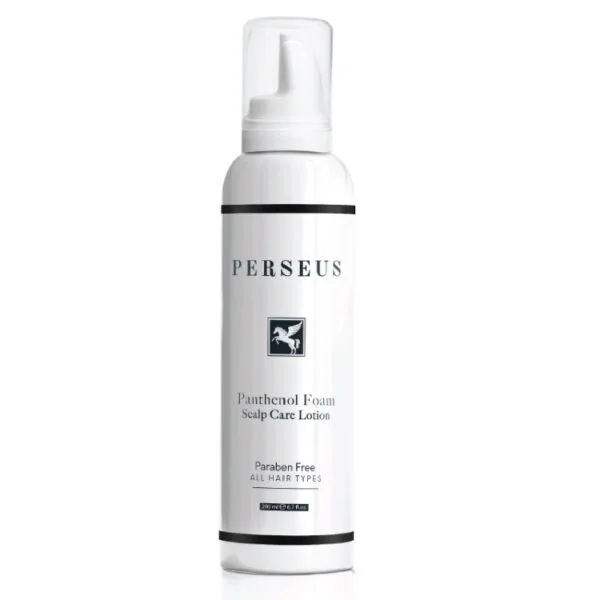
Perseus Panthenol Foam Scalp Care Lotion is safe from day one post-surgery. Apply gently to the recipient and donor areas after saline spray to soothe histamine-driven itch and support the scalp's natural pH balance.
Weeks Two Through Six
Continue with a sulfate-free, pH-balanced shampoo through this entire period without exception. This is the stage when patients most commonly make the mistake of returning to their usual commercial shampoo because the scalp looks healed on the surface. The sebum glands and microbiome are still recovering underneath, and the introduction of sulfates and alkaline formulas at this point is one of the most reliable ways to extend the itching window by weeks.
A repair shampoo formulated specifically for post-transplant scalps containing ingredients such as panthenol, biotin, aloe vera, and sodium hyaluronate maintains the healing environment without depositing the residue associated with commercial formulas. Wash frequency should stay at two to three times per week during this window. Over-washing strips the recovering sebaceous film and compounds scalp dryness.
Months Two Through Four
If itching returns or intensifies during this window, new follicle emergence is the most likely explanation. No specific medical treatment is needed. The focus should be on maintaining scalp hydration and reducing surface friction. An ozonized hair oil applied to the scalp two to three times per week delivers oxygen to follicular tissue, reduces surface dryness, and has anti-inflammatory properties that can ease the irritation associated with new hairs breaking through the epidermis. Apply 9 to 10 drops to the recipient area, massage gently, leave for 30 to 40 minutes, and rinse before washing.
Perseus Mesotherapy Serum applied via dermaroller during this period can also help. The micro-channels created by the dermaroller allow the active ingredients, including peptides and growth factors to reach the follicular layer directly, supporting faster anagen phase establishment and reducing the duration of the emergence-related itch phase.
Month Four Onward
Persistent itching beyond month four without a clear trigger should be investigated systematically before seeking medical evaluation. Conduct a full product audit: remove all products containing sulfates, silicones, synthetic fragrance, alcohol, and parabens from your routine for a minimum of four weeks. This single step resolves the majority of late-stage post-transplant itching cases.
If the itch resolves during the audit period, reintroduce products one at a time with at least two weeks between each introduction. The product that triggers the itch return is the culprit. If the itch does not resolve after a complete product audit, consult your transplant surgeon. At this stage, folliculitis, seborrheic dermatitis, or a pre-existing scalp condition are the most likely explanations all of which require professional evaluation and targeted treatment.
Days 1–14: Saline spray multiple times daily + panthenol foam + surgeon-prescribed antihistamine. Weeks 2–6: Sulfate-free repair shampoo, 2–3 washes per week maximum, no commercial products. Months 2–4: Ozonized hair oil 2–3 times per week on the recipient area + mesotherapy serum via dermaroller. Month 4 onward: Full product audit for 4 weeks before seeking medical evaluation.
- ✓ Panthenol (Provitamin B5)
- ✓ pH-balanced formula
- ✓ Sulfate-free
- ✓ Soothes redness and itching
- ✓ Safe from day 1 post-surgery