4000 Grafts in Turkey: The Right Choice for Your Hair Loss Stage?
- What Does 4000 Grafts Actually Mean?
- Who Needs 4000 Grafts in Turkey? Norwood Scale Guide
- FUE, Sapphire FUE, or DHI for 4000 grafts in Turkey?
- What Happens on the Day?
- Week-by-Week Recovery Timeline
- Cost of 4000 grafts in Turkey vs Other Countries
- How to Choose the Right Clinic for 4000 grafts in Turkey
- FAQs for 4000 hair grafts in Turkey
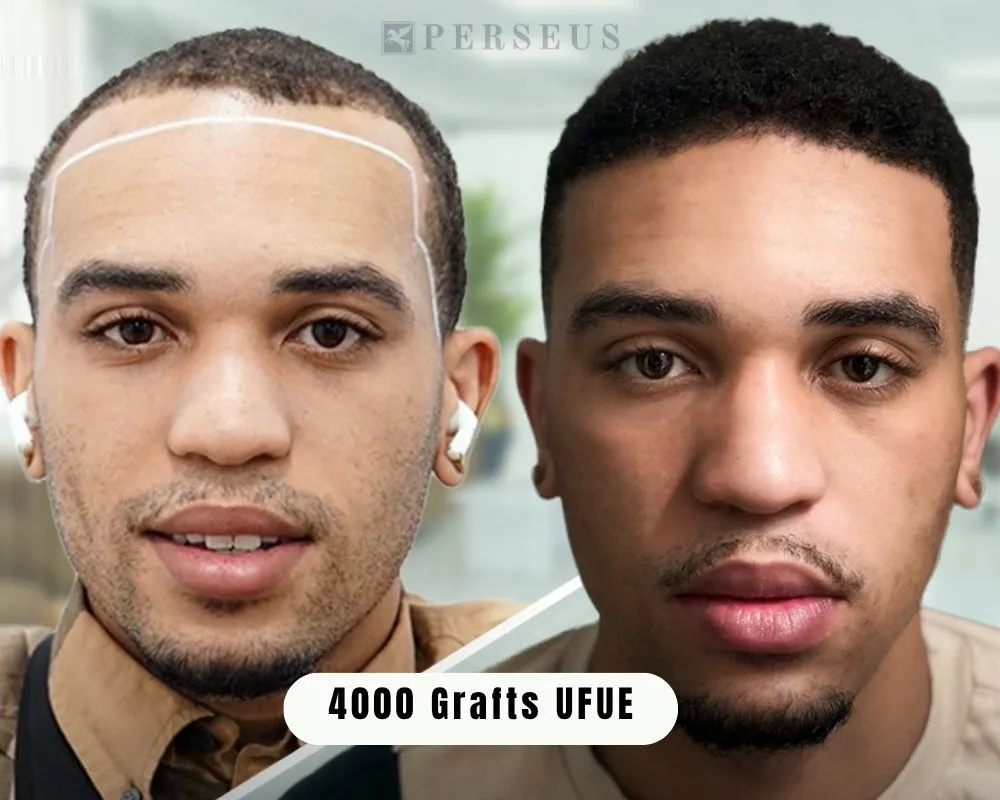
A 4000 grafts in Turkey is the most requested single-session procedure for patients with moderate to advanced hair loss. 4000 grafts hair tranplantation restores the hairline, mid-scalp, and crown at a fraction of the cost charged in Western Europe or North America without compromising on technique or results.
This guide covers everything: how many hairs 4000 grafts actually gives you, which Norwood stages qualify, how to choose between FUE, Sapphire FUE and DHI, what happens on the day, the full recovery timeline, and what to look for when choosing a clinic in Turkey.
There is no single type of procedure specifically for a 4,000-graft transplant. For example, in the image, you can see before-and-after photos of a 4,000-graft transplant performed using the Unshaven FUE method. However, it is also possible to use 4,000 grafts with many other modern techniques, such as Shaved FUE, Shaved DHI, Unshaven DHI, Shaved Neograft, and Unshaven Neograft.
What Does 4000 Grafts Actually Mean?
A graft is a small unit of tissue containing one or more hair follicles. The graft consists of the skin's surface, hair follicles, sebum, and hair shafts. Most grafts hold between 1 and 4 hairs, with the average sitting around 1.8 to 2.2 hairs per graft. This means 4000 grafts equals roughly 7,200 to 8,800 individual hairs placed in a single session.
Single-follicle grafts are used at the hairline for a natural look; double and triple grafts go into the mid-scalp and crown where density matters most. Your surgeon decides this split during planning, it is one of the decisions that affects how the result looks.
Who Needs 4000 Grafts in Turkey? The Norwood Scale Explained
The Norwood scale classifies male pattern hair loss from Stage 1 (minimal) to Stage 7 (extensive). A 4000 graft session is most suitable for Norwood Stage 4 and Stage 5 patients. Candidates at Stage 3 with a strong donor area or Stage 6 patients targeting partial coverage may also qualify.
The appropriate number of grafts also depends on the density of the donor area (ideally 70–80 grafts/cm²), hair thickness, and the elasticity of the scalp. Patients with curly or thick hair achieve fuller results with fewer grafts because each hair strand covers a larger area. As skin elasticity decreases with age, the procedure may become more challenging.
FUE, Sapphire FUE, or DHI — Which One Is Right for 4000 Grafts?
Most clinics in Turkey offer 3 main techniques for a session of this size. Each has real differences in speed, recovery, and results not just different marketing names.
What Happens During a 4000 Graft Hair Transplant?
A standard 4000 graft session runs 6 to 8 hours under local anesthesia. You are awake throughout but should not feel pain, only mild pressure at times. Here is what the hair transplant day for 4000 grafts in Turkey looks like:
Week-by-Week Recovery After a 4000 Grafts in Turkey
4000 grafts in Turkey has similar healing process with other hair grafting amounts. Recovery follows a predictable pattern. The most important thing to understand is that visible results do not appear quickly, patience is required.
How Much Does a 4000 Graft Hair Transplant Cost in Turkey?
Turkey offers significantly lower prices than Western Europe and North America — not because of lower quality standards, but because of lower operating costs, a favorable exchange rate, and high procedure volumes.
| Country | 4000 Grafts FUE | Sapphire / DHI | vs Turkey |
|---|---|---|---|
| 🇹🇷 Turkey | $2,200 – $4,000 | $3,500 – $5,000 | Base price |
| 🇬🇧 United Kingdom | $8,500 – $14,000 | $12,000 – $18,000 | Save ~65% |
| 🇺🇸 United States | $12,000 – $20,000 | $15,000 – $25,000 | Save ~78% |
| 🇩🇪 Germany | $7,000 – $12,000 | $9,000 – $15,000 | Save ~60% |
| 🇦🇪 UAE | $6,000 – $10,000 | $8,000 – $14,000 | Save ~55% |
What Is Usually Included in Turkey All-Inclusive Packages?
- Full procedure cost (anesthesia, operating room, surgeon and technician fees)
- 2–3 nights hotel accommodation (typically 4-star)
- Airport and hotel transfers
- Personal interpreter throughout the stay
- Post-op medications and hair care kit
- PRP treatment (included in most packages)
- 12-month remote follow-up and online consultations
How to Choose a Hair Transplant Clinic in Turkey
There are hundreds of clinics offering hair transplants in Istanbul and other Turkish cities. Here are the seven things that matter most:
- Accreditation: Look for JCI-accredited facilities or clinics approved by the Turkish Ministry of Health.
- Surgeon involvement: A qualified surgeon — not only technicians — must perform the extraction and channel opening. Ask directly before booking.
- Transparent pricing: Get a written quote listing everything. Ask whether there are charges not included.
- Independent reviews: Check Realself, Trustpilot, and hair loss forums. Look for consistency, not just the most recent reviews.
- Before and after photos: Ask for cases similar to your Norwood stage and hair type.
- Donor area planning: A good surgeon plans for future hair loss. Over-harvesting now leaves no options later.
- Single-patient policy: Ask how many patients the surgeon sees per day. Clinics running multiple simultaneous procedures split their attention.
Recommended Reading
✦ Ecosystem Balance: Scalp Microbiome After Hair Transplant — Learn how antibiotic use and pH imbalances affect protective scalp bacteria post-surgery and how to restore your natural skin barrier.
✦ Long-Term Healing: Itchy Scalp Months After Hair Transplant — Discover why chronic itching persists weeks or months post-surgery, how nerve regeneration plays a role, and safe ways to find relief.
✦ Optimal Timing: Best Season for Hair Transplant — Evaluate how weather conditions, sun exposure, and seasonal healing factors influence the ideal time of year for your hair restoration procedure.
✦ Post-Op Styling: Best Hairstyles for Hair Transplant Patients — Discover flattering haircuts and styling choices designed to conceal donor areas and showcase your growing density during recovery.
✦ Follicle Nutrition: Vitamin D and Hair Growth Following Hair Restoration — Understand the vital role vitamin D plays in hair follicle cycling and how optimal levels support faster recovery and density.


Receive offers, product alerts, styling inspiration and more. By signing up, you agree to our Privacy Policy.
- info@perseusstyle.com