8 Months After a Hair Transplant
Written by Perseus Editorial Team
Last Update: August, 2026
Medically reviewed by Senior Hair Transplant Specialists at Perseus Clinical Partner Network
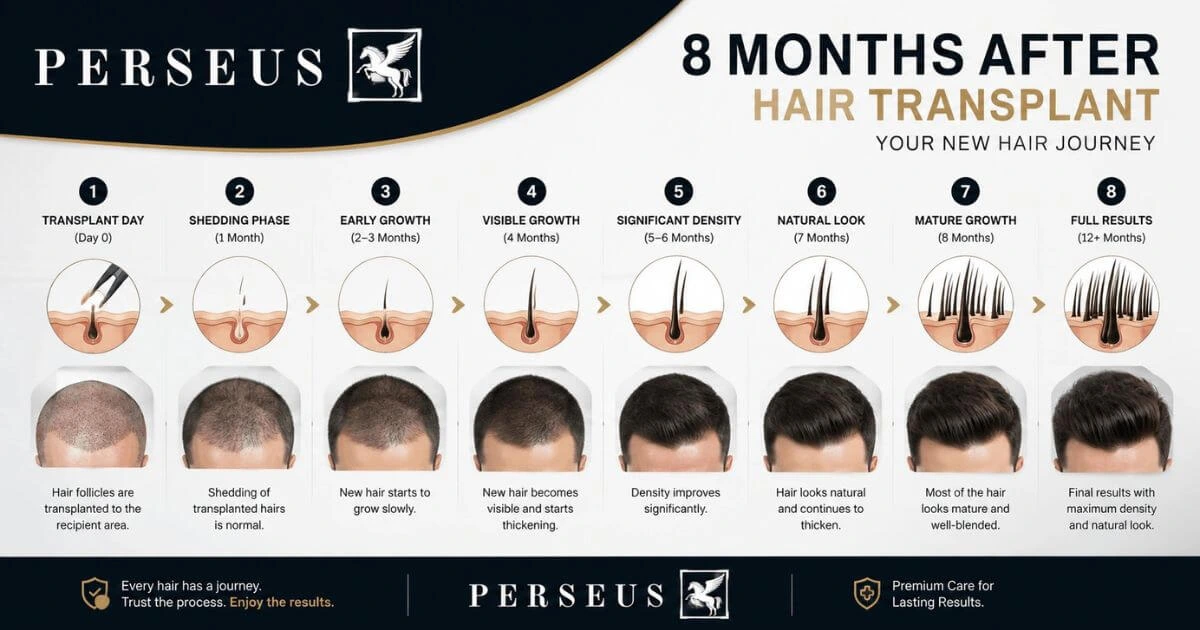
You’re one month past the seven-month mark, and the mirror is finally starting to agree with your patience. Eight months after a hair transplant, you’re much closer to the final result.
The transplanted hair no longer just sits there; it begins to behave like your other hair. It holds your hair together, responds to hair products, and reflects light in the same way. Nearly 70 to 80 percent of your recovery is completed during this period.
What’s the Situation in the 8th Month?
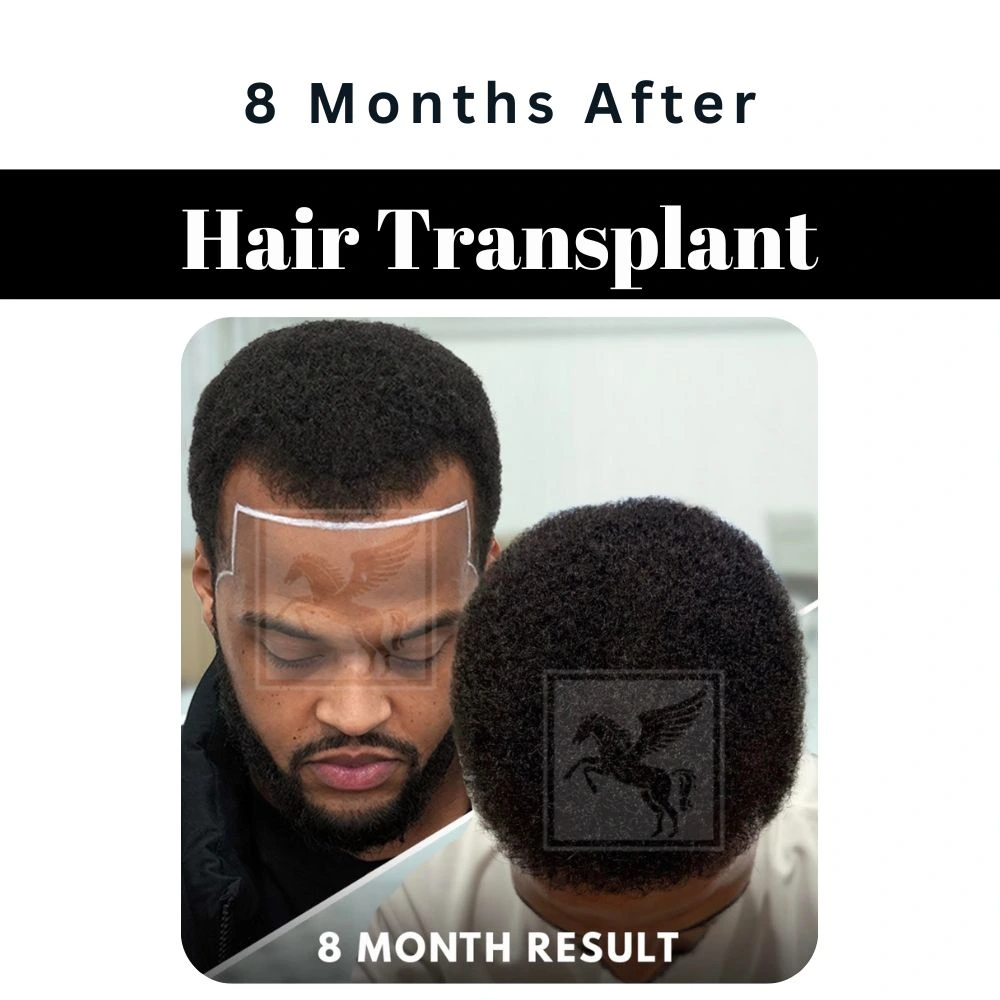
By the 8th month after a hair transplant, the goal for the transplanted grafts is no longer simply to survive. For grafts that have grown by this stage, there is no longer a struggle for survival, provided that hair loss has not resumed. The hair grafts have now entered the active growth and thickening phase.
This phase marks the period when the uneven results observed in the 6th and 7th months begin to even out. The remaining areas, particularly the crown, begin to catch up with the other areas; however, these areas generally remain the last to reach full maturity.
The rate of growth varies from patient to patient, and the crown area, in particular, may still be in the process of completing vascular healing at this stage. 8 months after a hair transplant, if you have experienced a normal healing process up to this point, it means you have now left behind many risks, such as post-op infection because of wound healing. On the other hand, if you do not see any visible changes compared to the 6-month mark, or if there is an abnormal appearance in the donor area, it is still advisable to consult with your surgeon regarding your post-operative care.
Month 8 Milestone Bullet Points
In the eighth month, the following changes occur simultaneously on your scalp.
- Your hair strands continue to thicken. The hair that began growing thin and sparse around the 3rd to 5th months is now visibly gaining thickness and pigment. You may not notice this difference between the 7th and 8th months, but we expect you to see a more noticeable difference between the 5th and 8th months.
- The hairline looks natural even under direct light and when you push your hair back.
- Coverage in the front and central scalp areas appears nearly complete; the transplanted area blends almost seamlessly with your own hair. In other words, we do not expect a situation like the artificial-looking front hairline seen in botched hair transplant results.
- The hair texture continues to soften. The stiff, stringy feel that some patients notice around the 4th to 6th months continues to soften as the hair shaft matures. Additionally, when you pull on a strand of hair, it does not snap immediately in the middle. Its elasticity strengthens.
- Sebum production is returning to normal. The sebaceous glands, which were reimplanted along with the follicles, are now functioning almost normally. As a result, the scalp appears less dry and less shiny compared to the early stages of the healing process.
Hairline, Mid-Scalp, and Crown Progress at Month 8
Month 8 hair transplant progress across scalp regions:
The condition of the follicles along the hairline 8 months later
By the 8th month, this area reaches its most complete appearance. The hairline should appear fully defined, thick, and natural, with no visible gaps or irregular spacing between the grafts.
Hair on the temples at 8 months after a hair transplant
Temple hair naturally emerges at a flatter, more acute angle than other scalp zones, which can slightly delay its alignment with surrounding hair. By Month 8, most patients notice the temples blending smoothly into the overall flow, though complete directional maturation often continues through Months 9 to 10.
Development in the center and sides of the scalp (parietal region)
Since this area has the richest blood flow on the scalp, it is generally the thickest and most mature-looking area at this stage. It often reaches 85% or more of its final density.
Slow development of the crown (top) region
This is still the slowest-developing area. Blood flow to the crown region is naturally weaker than to the front and side regions; therefore, full maturation here is generally not visible until the 15th–18th months. By the 8th month, even if all other areas appear nearly complete, you can expect the crown area’s final density to be between 50% and 65%.
| What Changes | Month 1 | Month 8 |
|---|---|---|
| Hair Growth | Transplanted hairs shed (shock loss) | Active growth, 70–85% of final density |
| Hair Thickness | No new strands present | Noticeably close to native strand thickness |
| Scalp Appearance | Redness, scabbing, visible graft sites | Fully healed, donor points essentially invisible |
| Hairline | Not yet defined | Fully defined, natural in all lighting |
| Crown Area | No growth | Catching up, 50–65% complete |
| Donor Area | Healing, some numbness | Point-shaped scars camouflaged, even at short lengths |
| Hair Texture | Too early to assess | Close to native texture |
| What to Do | Gentle washing only, no styling | Coloring, heat styling, short haircuts |
Perseus Recommends
If you want your hair to look thicker and fuller by the 8th month, you can try our Perseus Vitamins. With special ingredients like Vitamin E, ginseng, zinc, Vitamin C, and Vitamin B6, they nourish your hair from the roots.
Explore Perseus Vitamins →Visual changes you may notice during recovery in the 8th month and their causes
A few things can make the scalp look not quite normal even when recovery is going well:
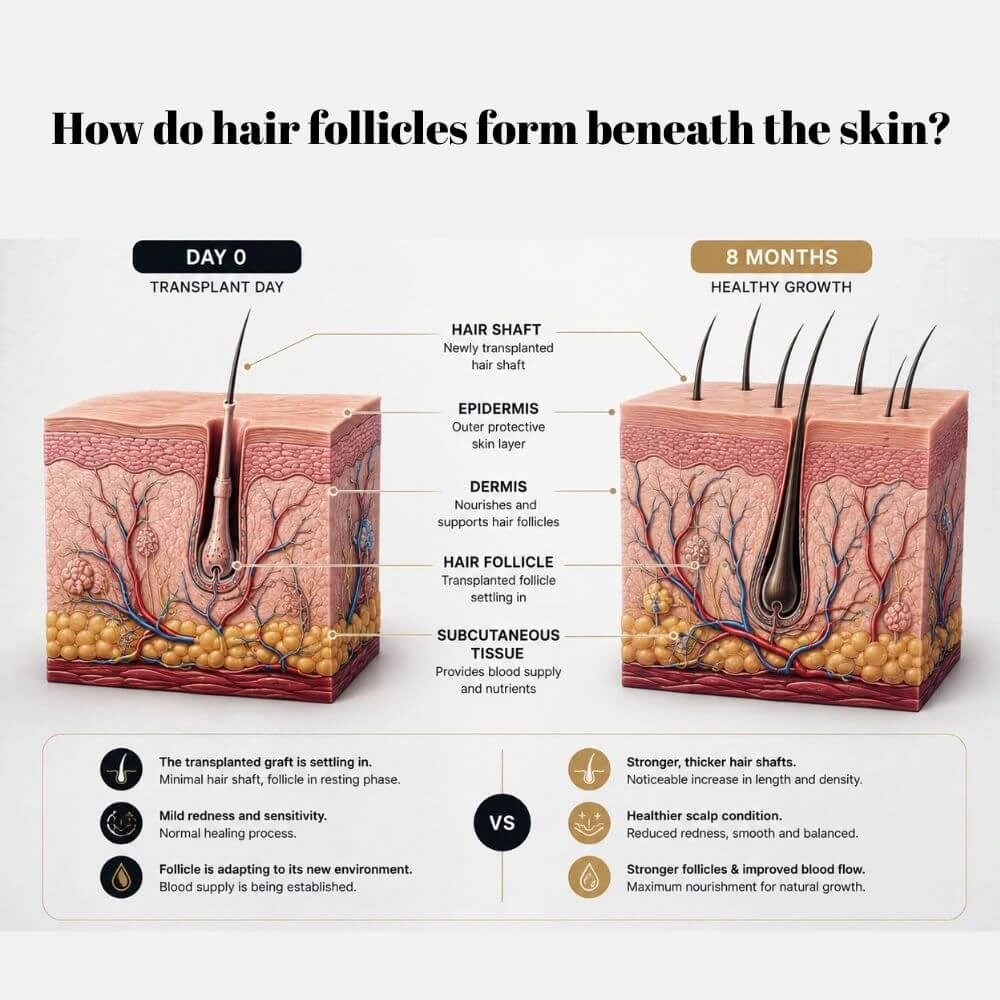
- Around the 8-month mark, the skin around your new follicles is still settling in. The tiny oil glands in the transplanted area are slowly getting back into their routine, which is why that spot might look a little shinier or feel slightly different than the rest of your scalp for now. You might also notice faint tone differences where the grafts were placed. That’s just your skin’s natural response as the tissue repairs itself, and it shows up a bit more on very fair or deeper skin tones.
- There may be slight variations in pigmentation. In very light or very dark skin tones, slight and temporary color variations may be visible in the transplanted area. This condition usually resolves on its own.
- Hair follicle openings have not yet fully settled. Until the surrounding skin has fully regenerated, hair follicle openings may be faintly visible upon close inspection, especially under bright, direct light.
- Mild dryness or flakiness. If your hair care routine is irregular, your scalp may appear duller or flakier than the rest of your skin. This is not a healing issue but a hair care issue, and it usually improves with regular, gentle washing and moisturizing.
Signs You’re On Track vs. Signs to Contact Your Clinic
Positive signs of recovery
- Hairline and mid-scalp look close to their final density
- Strands are noticeably thicker than they were at month 6
- Donor area is smooth, with no visible pattern of extraction points at normal grooming length
- Crown is showing gradual, steady improvement even if it’s not fully dense yet
- Scalp feels normal to the touch, no persistent tenderness or heat.
Adverse situations
- No visible change in the crown compared to month 6
- Any raised, discolored, or textured area in the donor zone
- Persistent redness, itching that doesn’t resolve, or small pustules
- Sudden shedding of hair that had already grown in
What You Can & Cannot Do at Month 8
Haircut in the 8th month of recovery is completely safe, including cuts with short scissors. Unlike linear scars, the dot-shaped scars in the donor area are concealed even with short hair lengths. This is one of the practical advantages of FUE-based techniques at this stage.
Hair coloring is permitted. It is generally considered safe for most patients starting in the 8th month; however, it is still recommended to perform a patch test before the first application and to use a gentle, ammonia-free formula.
Heat styling is now possible. There are no issues with normal use. Although the hair is approaching its mature texture, it is still recommended to use medium heat rather than the highest setting.
Restrictions on exercise and swimming are over. At this stage, you can swim as much as you like.
It’s still too early for sun exposure. If you’ve had your hair cut short, apply sunscreen to your scalp or wear a hat, as newly matured skin may be more sensitive to UV rays than fully established skin.
FAQs About 8 Months After a Hair Transplant
Why does my scalp still not look completely normal at 8 months?
Small differences in sheen, pigment, or texture around the recipient and donor areas are common at this stage and usually resolve by month 9–12 as the skin fully remodels around each follicle. Persistent redness or raised, textured patches are the things worth mentioning to your clinic, not subtle cosmetic differences.
Is 8 months enough to judge my final results?
Not quite. While 8 months gives a strong preview of the final outcome, especially in the hairline and mid-scalp, the crown and overall density typically need until month 12–15 to fully mature. Read what to expect at 7 months →
Will the donor area scars ever be visible?
With FUE, DHI, and Sapphire-based extraction, the donor area is left with hundreds of tiny point-shaped marks rather than one continuous line. By month 8, these are typically invisible at normal grooming lengths and remain camouflaged even with a short clipper cut, since there’s no single scar line for hair to have to grow over.
What are the signs of poor growth in the 8th month?
During this period, growth in the crown and temples may still be slow. However, the donor area, hairline, and the rest of the scalp should be covered with hair. Even if the temples aren’t completely filled with hair, you should be able to clearly see new hair strands. If your progress isn’t on track, poor growth may be an issue. Consult your doctor; they may prescribe supplements such as hair vitamins to help speed up your recovery.
References
- Jimenez, F., Alam, M., Vogel, J. E., & Avram, M. (2021). “Hair transplantation: Basic overview.” Journal of the American Academy of Dermatology, 85(4), 803–814.
- Mysore, V., & Sacchidanand, S. (2010). “Standard guidelines of care for hair transplantation.” Indian Journal of Dermatology, Venereology and Leprology, 76(4), 415–426.
- Bicknell, L. M., Kash, N., Kavouspour, C., & Rashid, R. M. (2014). “Follicular unit extraction hair transplant harvest: A review of current recommendations and future considerations.” Dermatology Online Journal, 20(3).
- Heva Clinic. “Post-Operative Patient Care and Recovery Guide.” Heva Clinic Patient Resources. Accessed August 17, 2026.
- Cosmetic Surgery Clinic Turkey. “Comprehensive Guide to Hair Restoration and Aftercare Protocols in Turkey.” Scalp Surgeries Resource Center.
Recommended Reading
✦ Recovery Milestones: Hair Transplant Timeline with Real Before & After Photos — Visual month-by-month progress and what to expect at each stage.
✦ Technique Spotlight: Unshaven Hair Transplant Guide — How no-shave procedures work, who qualifies, and key benefits.
✦ Hair Texture: What Actually Causes Frizzy Hair? — The science behind frizz, cuticle health, and effective smoothing solutions.
✦ Mid-Recovery Check: 5 Months After Hair Transplant — Growth expectations, texture changes, and early density progress.
✦ Scalp Biology: The Scalp Microbiome After Hair Restoration — Protecting your skin barrier and balancing microflora for optimal follicle health.


Receive offers, product alerts, styling inspiration and more. By signing up, you agree to our Privacy Policy.
- info@perseusstyle.com