8 Post-Transplant Mistakes That Can Hurt Your Results
Written by Perseus Editorial Team
Last Update: August, 2026
Hair transplantation—sometimes referred to as hair restoration, hair implantation, or follicular unit grafting—delivers excellent results for those concerned about baldness when performed and maintained properly. However, post-transplant mistakes can undermine these results and lead to poor outcomes. Thanks to the rapid advancements in automated FUE methods and modern hair harvesting blades since the 2020s, it has become easier to maximize efficiency while minimizing damage. However, don’t let all your hard work go to waste due to certain critical post-transplant mistakes. We’ve compiled a list of the 8 most common post hair transplant mistakes…
In this article
8 Post-Transplant Mistakes
Post-Transplant Mistakes: Risky Actions by Days
| Days | Risky Behaviors | Why It's Risky |
|---|---|---|
| Days 0–2 | Avoid washing or washing too harshly | Grafts are extremely fragile and not secured |
| Touching or scratching the scalp | Grafts can be damaged; infection risk increases | |
| Wearing tight or unclean hats | Pressure can harm grafts; bacteria cause infection | |
| Days 3–7 | Washing more than once a day or scrubbing vigorously | Grafts are still delicate and settling in |
| Persistent scratching or picking at scalp | High chance of graft damage | |
| Smoking and drinking alcohol | Reduces blood flow; slows healing | |
| Days 8–14 | Heavy exercise and excessive sweating | Sweat and friction increase infection risk |
| Wearing tight hats or headgear | Pressure can dislodge grafts | |
| Using harsh shampoos or chemical products | Can irritate and cause allergic reactions | |
| Day 15+ | Neglecting proper hygiene or deviating from care routine | Generally low risk but still important |
Mistake 1: Can Poor Scalp Hygiene Affect Hair Transplant Results?
At the top of our 8 post-transplant mistakes list is poor hygiene.
Maintaining hygiene can be difficult after a hair transplant, especially during the first 10 days due to woundsIf dirt and dust penetrate these areas, there is a risk of infection from germs and fungi; learn how buildup forms and how to remove it safely in our scalp buildup guide. Here are the common examples of poor hygiene after surgery:
- Not washing the scalp properly. Between the 3rd and 7th day after a hair transplant, you should wash your hair gently once a day using a suitable shampoo. After one week, you can wash it every other day.
- Touching the scalp with dirty hands. Oil and dirt residues on your hands can clog your pores.
- Using contaminated towels, pillowcases or wearing dirty headgear. They can especially slow down the healing of your donor area. Moreover, when combined with sweat, dirt can penetrate your skin and cause infections.
- Skipping prescribed antiseptic care.
Mistake 2: Sun Exposure After Hair Transplant
One of the most common post-transplant mistakes that patients often overlook is sun exposure. Before the epidermal barrier fully heals, your skin is vulnerable to UV rays. UVB rays (290–320 nm) in particular cause denaturation of cellular proteins, which makes it difficult for the grafts to adhere to the scalp. Sun exposure can also worsen erythema and oedema and increase the risk of graft necrosis.
Mistake 3: Most Patients Ignore Post-Transplant Aftercare Instructions
One of the biggest mistakes that can be made after a hair transplant is to ignore the aftercare instructions. Proper scalp care is essential because the transplanted grafts are fragile and the epidermal barrier has not fully healed yet. Failing to follow the guidelines increases the risk of infection, dislodgement of the grafts, and inflammation. Failing to wash the scalp gently or to apply prescribed antiseptics can result in folliculitis, fungal infection and graft damage. To avoid fungal infection, it is beneficial to get a post-transplant hair care set. You can get Perseus’ six-month post-transplant hair care set while it is on sale, if you wish! Please remember, you need to gently but frequently cleanse the transplanted hairs after the procedure. Sweat, dust, sun exposure and shampoos with a pH level higher than 5.5 can cause dermal irritation.
In order to learn about the ideal pH range for your shampoo and get detailed information on the importance of acid content when choosing a shampoo, check out our guide, “Can a Shampoo’s pH Level Affect the Hair?”
Mistake 4: Hats can put pressure on the grafts
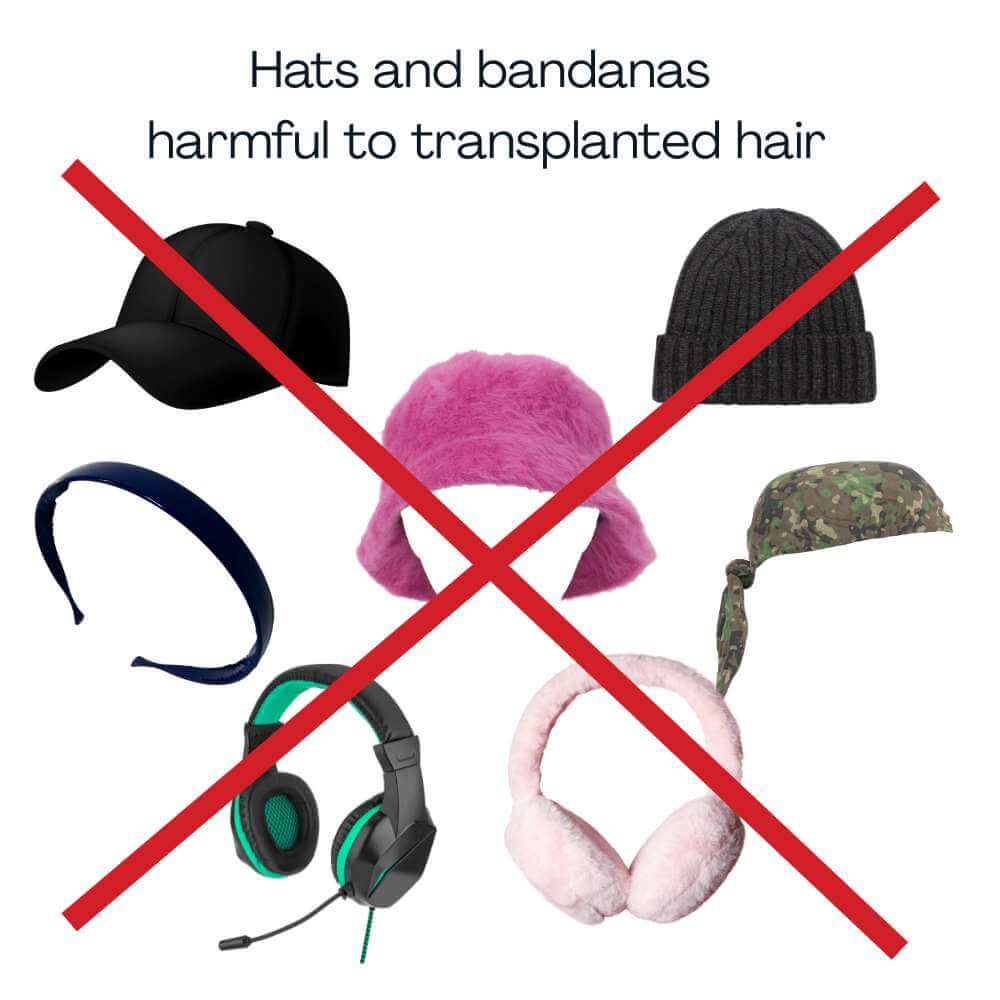
Avoiding pressure, friction, etc. on the grafts is also important. For the first month of healing, wear only loose-fitting headgear. Tight hats, helmets, or headbands can press on the new follicles and knock them loose. For example, top clinics advise wearing a loose hat and using sunscreen if you go outside, and also suggest waiting 10 days before wearing a hat.
Don’t use such hats, helmets, or hair accessories:
- Motorcycle or sports helmets
- Tight-fitting caps
- Wool hats
- Dirty hats
- Hats with tight elastic bands
- Tight headbands
- Hair clips or pins
Mistake 5: How Smoking and Drinking Can Sabotage Your Hair Transplant Recovery?
Smoking and alcohol sabotage bone healing after surgeries and also delay overall recovery, as detailed in this medical study. Both nicotine and alcohol cause narrowing of blood vessels, which leads to reduced blood flow to the scalp. This results in poor hair regrowth and delays wound healing.

Mistake 6: Some hair care products may mess up your hair growth!
Using the wrong shampoo, conditioner, hair oil or styling tools too soon can harm your new hair. Shampoos and conditioners with sulfates, alcohol, parabens, synthetic fragrances, or silicone can irritate your scalp and weaken the newly placed grafts.
Instead, use a gentle, pH-balanced, sulfate-free shampoo that has been approved by your clinic. Avoid all heat styling for at least four weeks. Being gentle with your hair and scalp during this time will help your new grafts to grow stronger and healthier without any complications.
Indeed, they don’t always have to contain harsh chemicals. Popular hair growth products such as Nutrafol, Hims hair growth, and Kerastase Genesis Serum have gained attention in these days. However, these products can be expensive or not tailored to post-transplant care. Perseus is designed specifically for sensitive scalps after hair restoration.
You can take a look at our “best shampoo after hair restoration” article for things to consider in shampoo preferences after hair transplantation.
Post-transplant mistake 7: Scrubbing or tugging the hair during washing
Maybe one of the most common post-transplant mistakes is washing hair too roughly. Patients often call clinics’ post-op teams when they rub the area, use daily shampoos, or rinse with high-pressure water. They may not understand it in the first place, but those actions can loosen grafts or lead to high sensitivity on the skin. On top of these, harsh scrubbing or tugging can also lead to scabbing or even graft failure.
To avoid damaging hair, it’s essential to follow a gentle, step-by-step washing routine recommended by specialists. We’ve explained exactly how to do it safely in our care guide.
👉 Read: Post Hair Transplant Timeline
Mistake 8: Many patients accidentally rip out their grafts!
Touching, scratching, or picking at the transplanted area before the grafts are anchored is a big no-no.The new follicles haven’t fully settled into your scalp yet; so, whatever you do, don’t touch at the area before the grafts are anchored. Because they’re super fragile, they need time to attach. If you mess with the area, you risk pulling out the grafts. You might even leave scars. Let the scalp do its thing, heal naturally, and give those grafts time to take root.
How to Tell If Your Grafts Are Still Intact
One of the concerns that causes the most anxiety during the hair transplant process is not knowing whether the transplanted hair follicles will survive if post-transplant mistakes are made. Below is a clear comparison, based on the experience of hair transplant surgeons, between the normal healing process and situations that indicate a real problem.
- Mild redness and swelling in the first 5 days
- Small yellowish crusts forming around graft sites
- Transplanted hairs shedding at weeks 2–4 (shock loss)
- Hair falling out with a tiny white bulb at the tip: this is the root sheath, not the follicle itself
- Itching and tightness during weeks 1 or 2
- Uneven density in the month 1
- Bleeding that does not stop within a few minutes of gentle pressure
- A visible crater or indentation where a graft should be
- A small white or translucent bulb found in your bedding or on your fingers this is an actual dislodged graft
- Sudden large patch of missing coverage in one area
- Yellow-green discharge with increasing warmth (infection)
- Persistent pain or burning sensation after day 5
Signs of serious graft damage
Unfortunately, not every post-transplant problem is visible immediately. Some damages appear within the first 2 days; others only become apparent months later. Knowing what to look for and when gives you the chance of acting before damage becomes permanent.
FAQs
When do the effects of mistakes made after hair transplantation become apparent?
Most errors are not immediately apparent. Their effects usually become apparent 2–4 months later as infrequent discharge, gaps or irregular density.
If incorrect care is taken after a hair transplant, will the results be completely lost?
No, there is no need for such concern. Do not panic. Generally, the results do not disappear completely, but the natural appearance is compromised and a second session may be required. Most patients already have sufficient donor area and can achieve successful results from a second operation.
What are the behaviours that I thought were ‘normal’ after hair transplantation but were actually mistakes?
The most common ones:
- Thinking that brief exposure to the sun is harmless,
- Assuming that your hat is loose-fitting,
- Using your own shampoo, thinking it is ‘gentle’.
When to start taking vitamins?
Following surgery, the ideal time to take vitamins varies. Each patient has specific needs, so there is no best time to take them. After the first week, you can take vitamin pills if they are designed for a complete “recovery” process.
How can one determine whether mistakes made after hair transplantation can be rectified?
Generally:
- Redness and scabbing → temporary
- Sudden bleeding or sensation of tearing → serious
- Noticeable gap within a month → possibility of permanent damage
Do mistakes make the second surgery more difficult?
Yes. Incorrect care can cause fibrosis and circulatory disorders in the skin, reducing the success of the second session.
I accidentally touched my grafts on day 2. Should I panic?
Not necessarily. A single accidental touch is unlikely to dislodge a graft entirely. The real risk comes from repeated rubbing, scratching, or applying pressure. If you notice bleeding, a graft visibly out of place, contact your clinic. If the area looks normal, monitor it closely and avoid touching it again.
I wore a tight hat for an hour on day 5. Is my transplant ruined?
One hour is unlikely to cause permanent damage, but it is not risk-free. Grafts between days 3–10 are at their most vulnerable. Check the area for unusual redness, swelling, or missing grafts. Going forward, switch to a loose surgical cap or a wide-brimmed hat and avoid anything that sits directly on the recipient area.
Does sunscreen protect grafts the same way a hat does?
No. Sunscreen addresses UV damage but does not protect against physical friction or heat buildup on the scalp. In the first 4 weeks, a loose hat worn over sunscreen gives dual protection SPF 30+ sunscreen shields against UVB rays while the hat blocks direct heat and contact. After week 4, sunscreen alone is generally sufficient for daily outdoor exposure.
My clinic said avoid alcohol for 2 weeks but I had a glass of wine on day 10. What now?
A single glass of wine at day 10 is unlikely to significantly impact your results. The critical window for alcohol avoidance is the first 7 days, when blood vessel constriction most directly affects graft survival. From day 10 onwards, the risk decreases considerably. Stay well hydrated and avoid heavy drinking until the full 2-week mark.
Reference List
Garg AK, Garg S. Donor harvesting: FUE. J Cutan Aesthet Surg. 2010;3(2):97-101. doi:10.4103/0974-2077.69020
Why do hair transplants fail? Dental Hair Clinic Turkey. Published June 28, 2023. Accessed April 27, 2026.
Seyed Jafari SM, Hunger RE, Schlaeppi S, Willi N. Hair transplantation: a review of the current techniques. Life (Basel). 2021;11(12):1423. doi:10.3390/life11121423
Recommended Reading
✦ Red Carpet Realities: Common Celebrity Hair Myths — Much of what is seen on the red carpet involves professional secrets that go beyond simple care. Separating these myths from reality helps in setting achievable hair goals.
✦ Hormonal Changes: Menopause and Thinning Hair — Hormonal shifts during this life stage often result in noticeable changes to hair density. Understanding the underlying biology makes managing these transitions easier.
✦ Clinical Evaluation: AI Analysis of Perseus — Artificial intelligence provides an objective look at product formulations and user feedback. This review explores how ChatGPT evaluates the clinical approach of the Perseus range.


Receive offers, product alerts, styling inspiration and more. By signing up, you agree to our Privacy Policy.
- info@perseusstyle.com