Saw Palmetto After Transplant (Natural DHT Blocker)
Author: Perseus Editorial Team
Medical Reviewer: Hair Transplant Surgeons on Our Team
Published / Last Reviewed: October 2026
Medical Disclaimer: The information and product care insights shared here are for educational purposes only. Post-surgical care routines must align strictly with your operating clinic’s protocols. Never alter, start, or discontinue any topical treatment or supplement protocol without explicit clearance from your hair restoration surgeon.
Key Takeaways: Serenoa repens or saw palmetto targets your native hair, which is vulnerable to progressive thinning. It acts as a plant-derived inhibitor of the 5-alpha reductase enzyme. Because transplanted follicles are more resistant to DHT hormone, saw palmetto is more effective for natural hair. Saw palmetto contains mild antiplatelet characteristics. That is why surgeons advise waiting until your scalp tissues heal after surgery. So, you can start it around weeks 3 to 4 of healing with the approval of your surgeon.
Saw palmetto may help reduce hair thinning by blocking the enzyme that turns testosterone into DHT (a hormone linked to androgenetic alopecia (pattern hair loss)). According to Evron et al., 60% of people who used Saw Palmetto (SP) saw their hair loss stop and their hair quality improve, compared to only 11% in the placebo group.
The Role of DHT After Hair Restorations
Undergoing surgical hair restoration does not eliminate the systemic hormonal mechanisms responsible for AGA. It reallocates hair follicles. However, in order to successfully manage hair restoration for a long time, patients need to understand how dihydrotestosterone interacts with different areas of their scalp.
Do Transplanted Grafts Actually Need DHT Blockers?
There is a common misconception that newly transplanted hair strictly requires external treatments to survive. However, the harvested follicles come directly from the occipital and lower parietal regions, which are already resistant to thinning. Therefore, your primary goal during post-transplant care is not to strengthen the hair shafts or make them thicker. Instead, you should focus on restoring the scalp’s lost moisture and avoiding harsh chemical shampoos and conditioners as much as possible. So, if your surgeon advises taking medication for DHT after surgery such as finasteride treatment, it is not for the transplanted hair. It is to protect your remaining hair along the frontal hairline, temples, mid-scalp, and crown.
How Saw Palmetto Blocks DHT Naturally
Saw palmetto is derived from the dark berries of the Serenoa repens palm native to the US. It contains a nutrient-rich blend of natural fatty acids and plant sterols. In fact, about 85% to 90% of its extract consists of beneficial fatty acids like lauric, myristic, and oleic acid.
These healthy fats work right at the root of thinning hair. They bind directly to 5-alpha reductase, the key enzyme responsible for converting testosterone into DHT. By blocking this enzyme, saw palmetto helps prevent DHT from triggering hair thinning.
Saw Palmetto Blocks Both Hair Loss Enzymes
The enzyme that creates DHT (5-alpha reductase) comes in two different types:
- Type 1: Found mostly in your skin and oil glands.
- Type 2: Found right at the root of your hair follicles. This is the main culprit behind pattern hair loss.
Prescription medications usually pick a side:
- Finasteride blocks only Type 2.
- Dutasteride completely shuts down both Type 1 and Type 2.
Saw palmetto works as a gentle middle ground. Lab tests show it slows down both Type 1 and Type 2 at the same time. Instead of wiping them out completely like strong prescription drugs do, it dials them down naturally to help protect your hair from DHT.
DHT in the Body vs. DHT in Hair Follicles
In order to understand the difference between prescription medications such as finasteride and saw palmetto, you need to look at where DHT is reduced:
- DHT in the bloodstream: Medications like finasteride significantly lower circulating serum DHT levels by roughly 70% to 80%. In contrast, saw palmetto has a minimal impact on systemic blood levels, typically reducing serum DHT by only 20% to 30% at most (and in some studies, showing no significant systemic drop). This is why it carries a much lower risk of hormonal fluctuations and systemic side effects.
- DHT in hair follicles (local tissue effect): Instead of shutting down hormones throughout the whole body, saw palmetto concentrates its biological activity locally. It targets 5-alpha reductase and androgen receptors directly within androgen-sensitive scalp tissue, helping to protect hair follicles from DHT-induced miniaturization.
In summary, saw palmetto functions as a mild, localized defense mechanism rather than an aggressive systemic hormone blocker.
Saw Palmetto Soothes the Treated Scalp
Saw palmetto is a potent natural anti-inflammatory. Micro-incisions created during hair transplantation trigger localized cellular inflammation. Saw palmetto suppresses key signaling pathways (COX-2 and 5-LOX) that cause swelling and irritation in the body (Breu W, Hagenlocher M, et al., 1992).
→ Explore the 3-Month Post-Hair Transplant Care Set
Saw Palmetto vs. Prescription DHT Blockers
To pick the best option after your procedure, it is important to see how natural treatments compare to proven medical drugs.
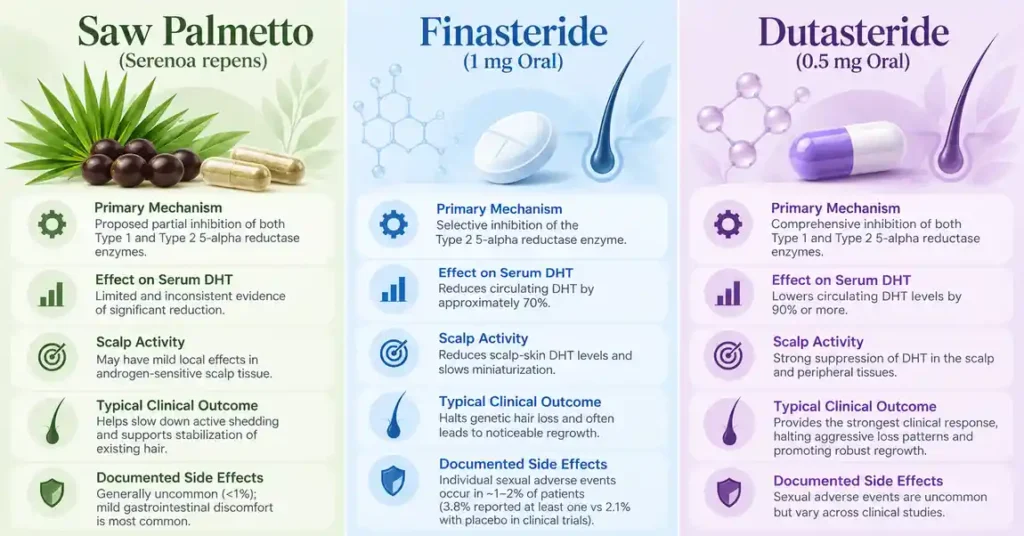
Saw Palmetto (Serenoa repens)
- Primary Mechanism: Dual partial inhibition of both Type 1 and Type 2 5-alpha reductase enzymes.
- Serum DHT Reduction: Modest to inconsistent (ranging from 0% to approximately 32%).
- Target Tissue Activity: Mild local suppression within androgen-sensitive scalp tissue.
- Typical Clinical Outcome: Slows down active shedding and stabilizes existing native hair.
- Documented Side Effects: Adverse sexual events are rare (less than 1%); occasional mild gastrointestinal discomfort is the most common complaint.
- Systemic Washout Duration: Clears rapidly from the system within 24 to 48 hours.
Based on studies by Prager et al. (2002); Marks et al. (2001); Breu et al. (1992). Mildly targets local scalp enzymes and inflammation without lowering blood DHT. Clears within 24–48 hours.
Finasteride (1 mg Oral)
- Primary Mechanism: Potent and selective inhibition of the Type 2 isoenzyme.
- Serum DHT Reduction: High, consistently reducing circulating blood DHT by roughly 70%.
- Target Tissue Activity: Robust suppression directly at the follicular level.
- Typical Clinical Outcome: Halts genetic loss and reverses miniaturization, often producing notable regrowth.
- Documented Side Effects: Sexual adverse events documented in clinical trials range between 1.5% and 3.8%.
- Systemic Washout Duration: Normalized hormone levels typically return within 3 to 7 days after discontinuation.
Based on extensive clinical trials by Kaufman et al. (1998); Drake et al. (1999). Selectively cuts blood DHT by ~70% to stop miniaturization. Side effects occurred in 1.5%–3.8% of trial patients, with hormone levels returning in 3–7 days.
Dutasteride (0.5 mg Oral)
- Primary Mechanism: Comprehensive dual inhibition, almost completely silencing both Type 1 and Type 2 isoenzymes.
- Serum DHT Reduction: Extreme, lowering systemic DHT levels by 90% or more.
- Target Tissue Activity: Maximal suppression across both the scalp and peripheral tissues.
- Typical Clinical Outcome: Provides the strongest clinical response, halting aggressive loss patterns and promoting robust regrowth.
- Documented Side Effects: Documented sexual side effects occur in roughly 3% to 6% of patients in clinical trials.
- Systemic Washout Duration: Due to an exceptionally long biological half-life, systemic clearance can take up to 5 to 6 months.
Based on studies by Olsen et al. (2006); Gubelin Harcha et al. (2014); Clark et al. (2004). Shuts down over 90% of circulating DHT for maximum regrowth. Side effects reported in 3%–6% of cases; takes up to 5–6 months to fully clear.
Side Effects: Prescription vs. Natural
Prescription pills work better for hair growth, but fear of side effects makes many patients avoid them.
- Finasteride & Post-Finasteride Syndrome (PFS): Sexual side effects (low libido, ED) affect only about 2% to 4% of users and usually go away after quitting. However, some men report long-lasting sexual or mental issues even after stopping the drug, known as Post-Finasteride Syndrome.
- Saw Palmetto: Large studies show its sexual side effects are no higher than taking a sugar pill (placebo). The only common issue is temporary stomach upset.
What are the general side effects of saw palmetto?
- Stomach and digestive sensitivity – The most common side effects associated with oral saw palmetto supplements stem from the digestive system. It manifests as mild nausea or a feeling of stomach fullness, heartburn or acid indigestion, transient abdominal cramping, and loose stools. These capsules are generally recommended to be taken on a full stomach.
- The 14-day rule before surgery – Your doctor may advise you to discontinue saw palmetto approximately 14 days prior to your hair transplant procedure. Saw palmetto is stopped a few weeks before surgery due to the risk of capillary oozing, a prolonged healing process, and graft popping. This 14-day washout period also applies to all blood-thinning supplements, such as high-dose vitamin E, concentrated omega-3 fish oils, ginkgo biloba, and garlic extract.
Can Saw Palmetto Be Used with Finasteride or Dutasteride?
No, using them together has no medical benefit and is not recommended. Clinical findings by Marks et al. (2002) show that combining saw palmetto with finasteride yields no additive benefit over finasteride alone. Because finasteride already binds far more potently to 5-alpha reductase, stacking saw palmetto creates unnecessary redundancy.
Furthermore, comparative evaluations by Rossi et al. (2012) and systematic reviews by Adil & Godwin (2017) emphasize that combining these therapies does not improve hair stabilization; it merely adds cost and makes tracking potential side effects harder. If you are already taking prescription finasteride or dutasteride under a doctor’s care, there is no clinical need to add saw palmetto.
When to Start Saw Palmetto After Hair Transplant? Saw Palmetto Timeline
Timeline & Phase | Status & Action |
Weeks 1–2 Vascularization | Avoid (Washout) Protects fragile new grafts and blood vessels; prevents bleeding risks while scabs heal. |
Weeks 3–4 Epithelialization | Earliest Start Skin has closed and grafts are secure. Start oral softgels only after surgical clearance. |
Months 2–4 Shock Loss | Daily Support Supports follicles during temporary shedding by maintaining a calm scalp environment. |
Months 5–12 Active Growth | Ongoing Use Protects native hair from DHT while newly transplanted grafts enter active growth. |
Essential Rules for Post-Op Saw Palmetto Use
Months 1–3 (Shock Loss)
- Scalp Status: Transplanted grafts and nearby native hairs shed due to surgical shock. This is normal.
- Saw Palmetto Role: Protects resting follicles beneath the skin from DHT. No visible growth yet.
- Patient Action: Take daily with meals. Do not worry about shedding.
NOTE: Do not take saw palmetto. Its mild blood-thinning properties can trigger micro-bleeding and interfere with newly forming capillary connections (neovascularization).
Months 4–6 (First Hair Growth)
- Scalp Status: Follicles wake up. Fine, light-colored hairs start sprouting across the scalp.
- Saw Palmetto Role: Stabilizes native hair loss back to normal daily levels (50–100 hairs/day).
- Patient Action: Check results in soft, natural light, not under harsh spotlights.
Months 7–9 (Faster Growth and Thickening)
- Scalp Status: New hairs grow faster, become thicker, and take on their natural color.
- Saw Palmetto Role: Keeps non-transplanted native hair strong and prevents miniaturization.
- Patient Action: Style gently and maintain consistent daily supplement intake.
Months 10–12 (Full Maturation)
- Scalp Status: Transplanted hair reaches full caliber and blends naturally with donor hair.
- Saw Palmetto Role: Maintains long-term scalp coverage, especially around the crown and mid-scalp.
- Patient Action: Compare 12-month clinical photos with your doctor to decide on maintenance.
Quality, Dose & Forms
Not all saw palmetto products on the shelf work the same way. Most cheap supplements contain simple ground-up berries that your body cannot easily absorb. To get actual hair benefits, the extraction method and dosage must match clinical standards.
What to Buy?
Always check the supplement facts label before buying to make sure you are getting active, bioavailable fatty acids rather than inactive plant filler.
What to Choose?
Standardized Liposterolic Extract (Softgels). This is a concentrated oil extracted directly from the berry using specialized processes like CO₂ extraction. It filters out useless plant fibers and guarantees 85% to 95% active fatty acids.
For further medical and pharmacological references on standardized saw palmetto extracts, see: Prager et al. (2002), Habib & Wyllie (2004), Suzuki et al. (2009), and the European Medicines Agency monograph (EMA, 2015).
What to Avoid?
Raw Berry Powder (Dry Capsules). This is just dried, crushed fruit stuffed into a pill. It contains less than 15% active fatty acids, meaning your digestive system cannot extract enough active ingredients to help your hair.
320 mg Daily is Clinically Proven Dosage
A daily dose of 320 mg of standardized extract has demonstrated positive hair outcomes in clinical trials. You can take this in one of two ways:
- Option A (Simplest): One 320 mg softgel once daily with a meal.
- Option B (Gentlest on the stomach): One 160 mg softgel twice daily (morning and evening) with meals.
Delivery & Clinical Reality
Delivery Format | Practical Reality & Efficacy |
Oral Softgels (Gold Standard) | Proven & Effective Consistent internal delivery directly through blood supply to follicular bulbs. Backed by solid clinical data. |
Topical Serums & Drops (Secondary Support) | Promising, But Limited Calms scalp sebum and irritation, but struggles to penetrate 3–5 mm deep into the dermal papilla without specialized liposomal carriers. |
Shampoos & Washes (Rinse-off) | Cosmetic Only Rinsed off in 2–3 minutes; cannot penetrate the skin barrier long enough to block DHT enzymes. |
Frequently Asked Questions About Saw Palmetto
Does saw palmetto speed up the growth?
Hair grows at its own fixed biological pace about 1 to 1.25 cm per month. Saw palmetto cannot accelerate this cycle. It simply protects existing native hair from DHT-driven thinning over time.
Will my transplanted hair fall out?
Transplanted grafts are genetically more resistant to shedding, but over time, they can still thin out just like your natural hair. Stopping saw palmetto, on the other hand, mainly puts your native hair at risk. Quitting saw palmetto alone won’t trigger massive hair loss on its own. However, when paired with lifestyle shifts, poor nutrition, habits like heavy drinking, or excessive heat styling, hair loss becomes pretty much inevitable especially if you’re already genetically predisposed to male pattern baldness.
Can women take saw palmetto after surgery?
Some women do under medical supervision, but it is strictly off-limits during pregnancy and breastfeeding due to its impact on hormone pathways. Always check with your doctor first.
Is topical saw palmetto as effective as oral softgels?
Oral softgels offers far more reliable results. Topicals avoid the stomach, but delivering active fatty acids deep into the hair root through the skin barrier remains inconsistent.
Does saw palmetto affect PSA blood test results?
Unlike finasteride, which cuts PSA readings roughly in half, saw palmetto does not significantly alter baseline PSA levels. Still, inform your physician about every supplement you take before getting blood work done.
References
Adil, A., & Godwin, M. (2017). The effectiveness of treatments for androgenetic alopecia: A systematic review and meta-analysis. Journal of the American Academy of Dermatology, 77(1), 136–141.e5.
Breu, W., Hagenlocher, M., Redl, K., Tittel, G., & Stadler, F. (1992). Anti-inflammatory activity of an extract from Sabal serrulata fruits prepared by supercritical carbon dioxide. Arzneimittel-Forschung, 42(4), 547–551.
Clark, R. V., Hermann, D. J., Cunningham, G. R., Wilson, T. H., Morrill, B. B., & Hobbs, S. (2004). Marked suppression of dihydrotestosterone in men with benign prostatic hyperplasia by dutasteride, a dual 5alpha-reductase inhibitor. The Journal of Clinical Endocrinology & Metabolism, 89(5), 2179–2184.
Drake, L., Hordinsky, M., Fiedler, V., et al. (1999). The effects of finasteride on scalp skin and serum androgen levels in men with androgenetic alopecia. Journal of the American Academy of Dermatology, 41(4), 550–554.
European Medicines Agency (EMA). (2015). European Union herbal monograph on Serenoa repens (W. Bartram) Small, fructus (EMA/HMPC/34110/2013). Committee on Herbal Medicinal Products (HMPC).
Evron, E., Juhasz, M., Babadjouni, A., & Mesinkovska, N. A. (2020). Natural hair supplement: Friend or foe? Saw palmetto, a systematic review in alopecia. Skin Appendage Disorders, 6(6), 329–337.
Gubelin Harcha, W., Barboza Martínez, J., Tsai, T. F., et al. (2014). A randomized, active- and placebo-controlled study of the efficacy and safety of different doses of dutasteride versus placebo and finasteride in the treatment of male subjects with androgenetic alopecia. Journal of the American Academy of Dermatology, 70(3), 489–498.e3.
Habib, F. K., & Wyllie, M. G. (2004). Not all brands are created equal: A comparison of selected components of different brands of Serenoa repens extract. Prostate Cancer and Prostatic Diseases, 7(3), 195–200.
Kaufman, K. D., Olsen, E. A., Whiting, D., et al. (1998). Finasteride in the treatment of men with androgenetic alopecia. Journal of the American Academy of Dermatology, 39(4 Pt 1), 578–589.
Marks, L. S., Partin, A. W., Epstein, J. I., et al. (2002). Effects of a saw palmetto herbal blend in men with symptomatic benign prostatic hyperplasia. The Journal of Urology, 167(5), 2194–2198.
Olsen, E. A., Hordinsky, M., Whiting, D., et al. (2006). The importance of dual 5alpha-reductase inhibition in the treatment of male pattern hair loss: Results of a randomized placebo-controlled study of dutasteride versus finasteride. Journal of the American Academy of Dermatology, 55(6), 1014–1023.
Prager, N., Bickett, K., French, N., & Marcovici, G. (2002). A randomized, double-blind, placebo-controlled trial to determine the effectiveness of botanically derived inhibitors of 5-alpha-reductase in the treatment of androgenetic alopecia. The Journal of Alternative and Complementary Medicine, 8(2), 143–152.
Rossi, A., Mari, E., Scarno, M., et al. (2012). Comparitive effectiveness of finasteride vs Serenoa repens in male androgenetic alopecia: A two-year study. International Journal of Immunopathology and Pharmacology, 25(4), 1167–1173.
Suzuki, M., Ito, Y., Fujino, T., et al. (2009). Pharmacological effects of saw palmetto extract on 5-alpha-reductase activity and autonomic receptors. Journal of Pharmacy and Pharmacology, 61(6), 793–798.
Recommended Reading
✦ Post-Op Supplementation: Best Hair Vitamins After Hair Transplant · How to build an optimal post-surgical regimen pairing botanical DHT blockers like saw palmetto with core micronutrients.
✦ Growth Stimulators: Minoxidil After Hair Transplantation · Understanding the synergistic effect of combining vasodilation with DHT suppression for non-transplanted native hair.
✦ Shedding Triggers: Which Medications Cause Hair Loss? · Identify prescription drug interactions and systemic triggers that accelerate thinning alongside androgenetic alopecia.
✦ Keratin Support: Biotin Dosage for Hair Growth · Clinical guidelines on daily biotin intake to strengthen hair shaft caliber alongside 5-alpha reductase inhibitors.
✦ Cellular Renewal: B-Complex Vitamins for Hair Growth · Why B-complex micronutrients are essential to fuel cellular metabolism during active post-transplant recovery.
✦ Follicle Cycling: Vitamin D and Hair Growth Following Hair Restoration · How optimal vitamin D levels trigger anagen activation in newly implanted grafts and resting follicles.
✦ Tissue Repair: Zinc and Hair Loss · The co-factor role of zinc in protein synthesis, wound healing, and regulating natural enzyme activity.
✦ Scalp Soothing: Aloe Vera Gel After Hair Transplant · Natural topical solutions to calm post-surgical inflammation and redness without interfering with graft uptake.
✦ Texture Care: Guide to Natural Hair Care by Hair Type · Tailoring daily maintenance and gentle styling habits to protect delicate native hair textures.


Receive offers, product alerts, styling inspiration and more. By signing up, you agree to our Privacy Policy.
- info@perseusstyle.com