B-Complex Vitamins for Hair Growth
Written by Perseus Editorial Team
Last Update: October, 2026
Medical Disclaimer: The information and product care insights shared here are for educational purposes only. Post-surgical care routines must align strictly with your operating clinic’s protocols. Never alter, start, or discontinue any topical treatment or supplement protocol without explicit clearance from your hair restoration surgeon.
The B-complex vitamins support hair regrowth by promoting cellular metabolism, red blood cell production, and keratin synthesis. If there is an underlying deficiency, B-complex vitamins used for hair growth. Vitamin B Complex for hair growth, Biotin supports keratin production; vitamins B12 and folic acid provide oxygen and nutritional support, vitamin B5 helps with hydration, and vitamin B3 supports microcirculation… These are the hair vitamins that a single strand of hair needs most to stay healthy, shiny, and long.
What are the B-complex vitamins, and how many are there?
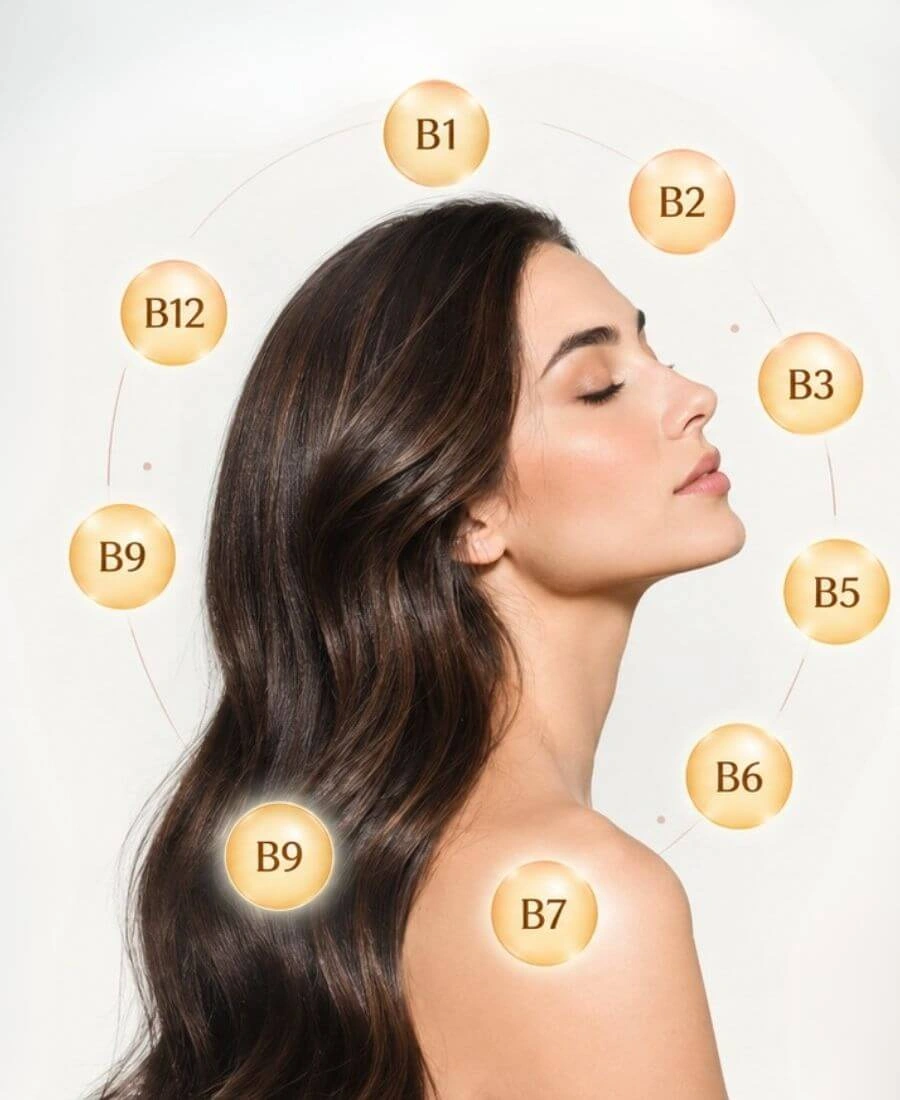
They are 8. B1 (Thiamine), B2 (Riboflavin), B3 (Niacin), B5 (Pantothenic Acid), B6 (Pyridoxine), B7 (Biotin), B9 (Folic Acid), and B12 (Cobalamin).
B-group cofactors that are not classified as true vitamins but are known to benefit hair include:
- Inositol (formerly B8): Strengthens hair follicle cell membranes and maintains scalp sebum balance.
- Choline (formerly B4): Supports cellular structure, facilitating nutrient transport to the roots.
- PABA (formerly B10): Protects roots from free radical damage and helps prevent premature graying.
How B Vitamins Support Hair
B-complex vitamins offer many benefits that hair needs, ranging from keratin synthesis to red blood cell production, and from moisturizing support to scalp nourishment.
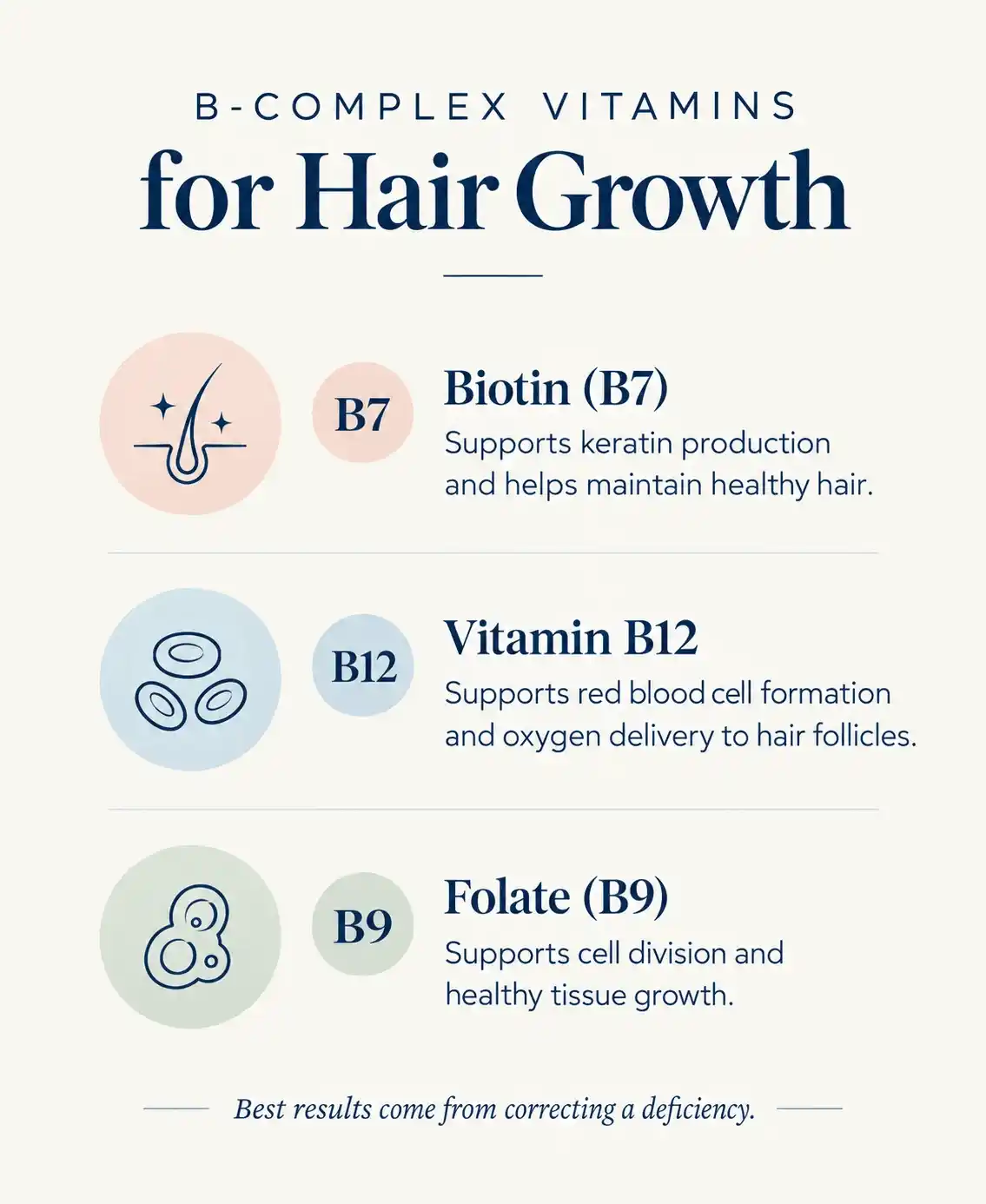
Biotin (B7): Builds keratin to prevent brittle strands and breakage.
Vitamin B12 & Folate (B9): Carries oxygen and vital nutrients directly to hair follicles.
Niacin (B3): Boosts scalp blood flow to energize hair roots.
Pantothenic Acid (B5): Hydrates the scalp and improves hair strength and elasticity.
Thiamine (B1): Protects follicle cells from stress and fuels growth metabolism.
Riboflavin (B2): Aids iron absorption and cellular energy in the follicles.
Pyridoxine (B6): Strengthens hair fibers and supports natural pigmentation.
Does vitamin B complex help in hair growth?
A vitamin B complex not only contributes to hair growth. In fact, it is essential and indispensable for hair growth. They are essential for hair growth, keratin synthesis, oxygen transport to hair follicles, and cell division. Without these vitamins, the body cannot produce healthy hair. B vitamins are water-soluble. If your body already has enough B vitamins, any excess you consume will not provide extra strength to your hair follicles or promote rapid hair growth; it is excreted directly in your urine. Therefore, supplements only stop hair loss and stimulate growth when blood levels are low (in cases of B vitamin deficiency).
Most specialists recommend continuing hair vitamins for at least 6 months after transplant. Add 2 bottles to your cart and use code BUY2SAVE20 at checkout for 10% off your order.
→ Shop Hair Vitamins — Biotin, Ginseng & Zinc
Which vitamin B is the best for hair growth?
Biotin (B7), Niacin (B3), Pantothenic Acid (B5), B12 and Folate (B9) are the best vitamins for hair regrowth and post-transplant healing. They create red blood cells and support the rapid cell renewal needed for hair growth.
Is B6 or B12 better for hair?
Vitamins B6 and B12 have completely different functions when it comes to hair health. In other words, it cannot be said that one is definitively better than the other; on the contrary, these two vitamins work together. Vitamin B6 regulates amino acid metabolism for the formation of hair protein structures and aids in the production of melanin, which preserves hair color and structural integrity. Vitamin B12, on the other hand, focuses on cell division and the formation of red blood cells, ensuring that sufficient oxygen and nutrients reach the scalp and hair follicles.
Do You Need a Supplement?
Only if your body is running on empty. Low levels of biotin, B12, riboflavin (B2), and folate are clinically linked to hair thinning and increased shedding. Supplementation reverses loss primarily by correcting these shortfalls.
When Supplements Work (and When They Don't)
Hair follicles are among the fastest-dividing cells in the human body, making them extremely sensitive to nutrient drops. Clinically low levels of biotin (B7), B12, riboflavin (B2), or folate (B9) starve follicular matrix cells and restrict oxygen flow to the scalp, triggering telogen effluvium (diffuse hair shedding). In these cases, targeted supplementation restores cellular division and brings shedding back to a normal baseline.
Why doesn’t more mean faster growth? B vitamins are water-soluble. Once your bloodstream reaches tissue saturation, your kidneys simply filter out the excess and excrete it through urine. Megadosing high-potency supplements when your levels are already normal will not speed up your hair growth cycle or double your strand thickness.
- Deficiency: If your body lacks B vitamins, hair thinning or hair loss can occur. Taking a supplement or eating a balanced diet corrects the problem and restores normal growth.
- No deficiency: If your B vitamin levels are already normal, taking extra B complex will not make your hair grow faster or thicker
For most healthy adults, a balanced diet provides sufficient B-complex vitamins without the need for supplements. To nourish your hair follicles naturally, prioritize whole eggs (rich in biotin), poultry, fish, organ meats, legumes, dark green leafy vegetables, and nutritional yeast. Check out this article to learn about the best foods for hair growth: 7-Day Hair Growth Meal Plan.
FAQs about B-Complex Vitamins for Hair Growth
Do Your Hair Symptoms Point to a B-Vitamin Imbalance?
Diffuse shedding, brittle hair shafts, and an unusually flaky or inflamed scalp often suggest a potential B-vitamin shortfall, but these symptoms rarely appear in isolation. Because B vitamins work synergistically to regulate cell turnover and oxygen transport, an insufficiency typically presents with subtle co-occurring signs across your body:
- Brittle Strands & Peeling Nails: Often linked to poor keratin synthesis associated with low biotin (B7).
- Increased Hair Shedding & Fatigue: May point to reduced red blood cell production and oxygen delivery, common in folate (B9) or B12 deficits.
- Flaky, Irritated Scalp & Mouth Cracks: Frequently related to riboflavin (B2), niacin (B3), or B6 shortfalls affecting epidermal barrier repair.
Because these symptoms overlap heavily with iron deficiency, thyroid dysfunction, and stress-related shedding (telogen effluvium), a routine blood panel is the only reliable way to pinpoint an exact deficiency before supplementing.
Which vitamins grow hair the fastest?
Indeed, it is not possible to promote hair growth with a single vitamin that would be unrealistic. However, if we had to single out one vitamin, Vitamin B12 (Cobalamin) would rank first in terms of speed and biological mechanism of action. Rapid hair growth is directly linked to B12 at the cellular level. Hair follicle matrix cells are the second-fastest dividing cell group in the human body, after bone marrow. Vitamin B12 is an essential coenzyme for DNA synthesis and rapid cell turnover. Without B12, the hair follicle cannot produce new cells, and the transition to the growth phase slows down.
Can B12 regrow lost hair?
It can regrow lost hair only if the hair loss was triggered by a clinically diagnosed B12 deficiency. Once serum B12 levels are restored through targeted supplementation or dietary correction, cellular division resumes, the hair cycle normalizes, and shed hair typically regrows within 3 to 6 months. However, if hair loss stems from androgenetic or scarring alopecias, B12 supplements will not reactivate damaged or scarred follicles.
Can too much vitamin B cause hair loss?
Yes, taking B vitamins far above your body’s daily requirement can be harmful. Never use high-potency supplements without consulting a physician. For instance, while the recommended dietary allowance (RDA) for Vitamin B6 (Pyridoxine) is just 1.3–1.7 mg per day, some hair supplements deliver over 100 mg per serving. Chronic megadosing of Vitamin B6 above tolerable upper limits can cause sensory peripheral neuropathy, a serious form of nerve damage characterized by numbness, tingling, and loss of coordination in the hands and feet. Always verify your blood levels before introducing high-potency complexes into your routine.
References
- National Institutes of Health, Office of Dietary Supplements. (2023). Biotin: Fact Sheet for Health Professionals. NIH.
- National Institutes of Health, Office of Dietary Supplements. (2024). Vitamin B12: Fact Sheet for Health Professionals. NIH.
- Guo, E. L., & Katta, R. (2017). Diet and Hair Loss: Effects of Nutrient Deficiency and Supplement Use. Dermatology Practical & Conceptual (PubMed Central).
- American Academy of Dermatology Association. (2022). Hair Loss: Can Supplements Help? AAD.
Recommended Reading
Continue reading the articles on this site
✦ Post-Op Nutrition: Best Hair Vitamins After Hair Transplant — Healthy hair requires more than just B vitamins; discover which essential vitamins and minerals are critical for graft survival and faster recovery.
✦ Growth Science: Vitamin D and Hair Growth Following Hair Restoration — Learn how vitamin D, another foundational hair-nourishing nutrient, regulates follicle cycling and boosts hair growth.
✦ Targeted Formula: Hair Vitamin with Biotin, Ginseng & Zinc — Discover our specialized daily hair vitamin formula crafted to combat hair thinning and support strong root density.
Recommended Books
- Diseases of the Hair and Scalp – Arthur Rook & Rodney P. R. Dawber
- Hair and Scalp Disorders: Medical, Surgical, and Cosmetic Treatments – Amy J. McMichael & Maria K. Hordinsky
- Modern Nutrition in Health and Disease – Katherine L. Tucker, Christopher P. Duggan, Gordon L. Jensen, Karen E. Peterson
- Rook’s Textbook of Dermatology – Christopher Griffiths, Jonathan Barker, Tanya Bleiker, Robert Chalmers, Daniel Creamer
Videos You Might Want to Watch
- Biotin for Healthy Hair? No! The B-vitamin Supplement That Actually Works for Hair Loss & Thinning – Dr. Patricia Mills MD
- How to Get Thick and Shiny Hair – Dr. Eric Berg DC
- I Took B Vitamins For 30 Days, Here’s What Happened – Dr. LeGrand


Receive offers, product alerts, styling inspiration and more. By signing up, you agree to our Privacy Policy.
- info@perseusstyle.com