Biotin Dosage Needed for Hair Growth
Written by Perseus Editorial Team
Last Update: September, 2026
Medical Disclaimer: The information and product care insights shared here are for educational purposes only. Post-surgical care routines must align strictly with your operating clinic’s protocols. Never alter, start, or discontinue any topical treatment or supplement protocol without explicit clearance from your hair restoration surgeon.
Biotin, also known as vitamin B7 or vitamin H, is a water-soluble B-complex vitamin. It acts as a coenzyme that supports keratin production. This helps strengthen the hair shaft and cuts down on hair loss from breakage. Finding the right biotin dosage for hair growth depends on your current hair health. Biotin turns fatty acids, glucose, and amino acids into energy, helping keep hair follicles in the active growth phase longer. Below, you will learn how biotin contributes to follicle metabolism.
In This Article (Table of Contents)
How Biotin (Vitamin B7) Supports Follicle Metabolism
As is well known, hair shafts are composed of keratin, a fibrous structural protein made up of amino acids. Biotin-dependent enzymes facilitate the biochemical reactions necessary for the cross-linking of these keratin proteins. When biotin levels in your body are sufficient, the matrix cells in the hair follicle receive the metabolic support needed to form flexible and break-resistant hair fibers.
- B7 and Keratin Building – Biotin gives your body the tools to build keratin, the primary protein in every hair strand. It breaks down essential fats and proteins from your diet, giving your hair the strength it needs to resist snapping.
- Cell Renewal and Growth – The cells inside your hair roots divide faster than almost anything else in your body. They rely on B7 for fuel, keeping the follicles energized so hair stays in its active growth phase longer.
The Ideal Biotin Dosage for Hair Growth: RDA vs. Supplements
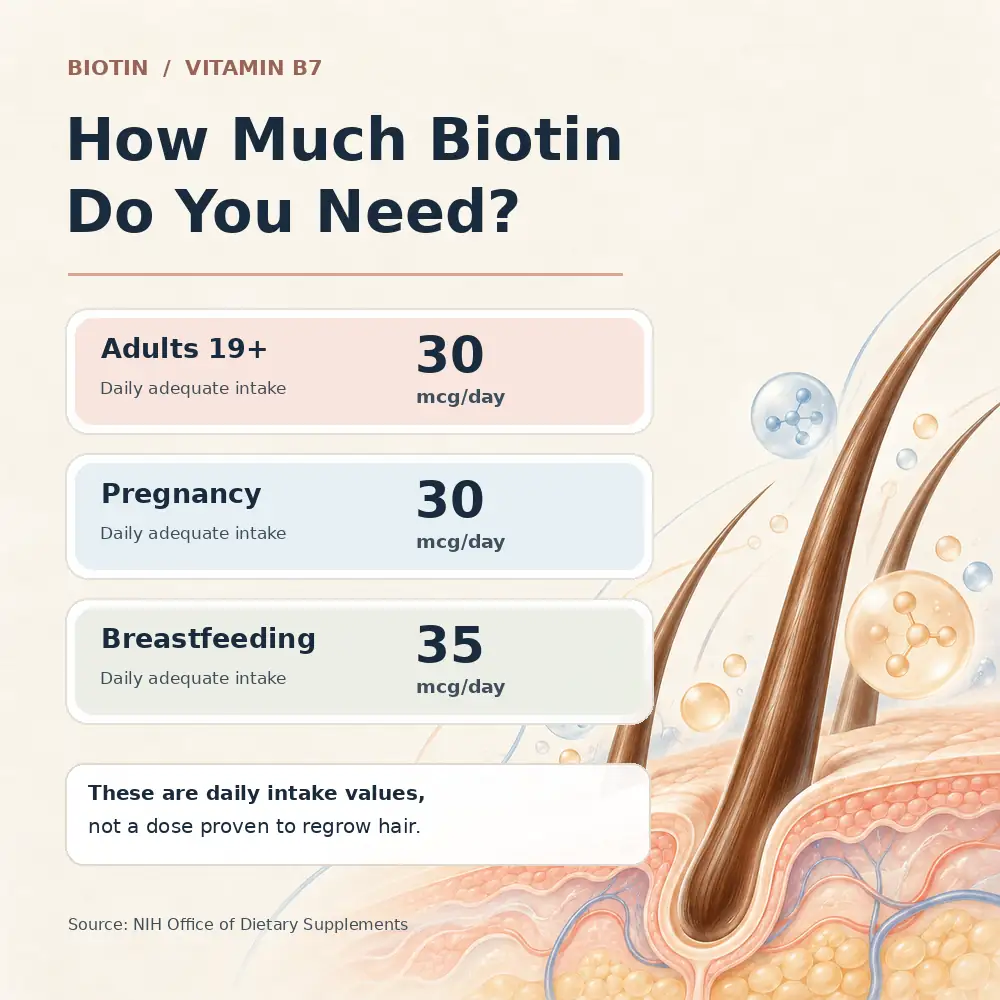
Health authorities establish an adequate intake (AI) rather than a strictly recommended dietary allowance (RDA) for biotin, as healthy populations rarely experience severe shortages.
- Adult Men & Women (19+): 30 micrograms (mcg) per day
- Pregnancy & Lactation: 30 to 35 mcg per day
You can easily get this from a normal, balanced diet. Cooked eggs, salmon, sunflower seeds, almonds, beans, and sweet potatoes all pack plenty of biotin your body can actually use. Friendly gut bacteria also make small amounts right in your digestive tract.
Biotin works best when supported from both the inside and outside. This complete 3-month regimen combines nutrient-rich hair vitamins with a biotin-infused nourishing shampoo and soothing foam to protect sensitive grafts and support healthy follicle recovery.
→ Explore the 3-Month Post-Hair Transplant Care Set
Why Commercial Supplements Offer Mega Biotin Doses?
Most over-the-counter hair gummies and capsules deliver anywhere from 2,500 mcg to 10,000 mcg per serving. While these numbers sound impressive on product labels, taking massive amounts will not double your hair growth rate. Biotin dissolves in water. Once your intestinal transporters absorb what your cells require, your kidneys filter out the surplus and flush it out through urine.
Target Dosage After Hair Loss or Hair Transplants
When dealing with telogen effluvium or recovering from a hair restoration procedure, selecting an effective biotin dosage for hair growth helps nourish recovering grafts without overloading your kidneys:
- Standard Recovery Dosing: A daily intake of 2,500 mcg to 5,000 mcg is usually sufficient to support active keratin building during root recovery.
- Tolerance and Safety: Because the body eliminates excess B7, this range supplies maximum cellular support to weakened follicles while staying gentle on your kidneys.
When Does Biotin Help Hair Grow Back?
Biotin only works if you are not getting enough of it in the first place.
- Fixing a Real Deficiency: If sudden shedding (telogen effluvium) starts because your body is genuinely running low on B7, taking it can get your hair back on track. People usually run low after long courses of antibiotics, stomach or gut problems that mess with nutrient absorption, during pregnancy, or because of rare gene mutations that stop the body from recycling biotin.
- The Truth About Genetic Thinning: Biotin will not stop male or female pattern baldness (androgenetic alopecia) on its own. Pattern hair loss comes down to hormones and genes. Hair roots shrink because they are sensitive to DHT, and biotin simply cannot block DHT or change your DNA. It can make the hair you have feel a bit thicker, but it will not stop genetic hair loss.
Lab Test Interference - Biotin Can Mess Up Blood Tests
High doses of biotin (excessive biotin ) will not necessarily harm your body, but they can completely throw off your routine lab results.
What the FDA Warns About: Taking high-dose biotin (especially over 5,000 mcg) can cause false readings on common lab tests. Many hospital machines use biotin to measure hormones and proteins in your blood. If your system is flooded with it, you might get falsely normal troponin levels during heart trouble, or your thyroid numbers (TSH, free T3, and free T4) could look completely out of balance when they are actually fine. [Learn more from official guidelines: FDA Safety Communication, American Thyroid Association, Biotin Interference with Laboratory Assays]
What You Should Do Before Lab Work: Stop taking high-dose biotin roughly 48 to 72 hours before any scheduled blood test. This gives your kidneys enough time to clear the extra vitamin out of your bloodstream so your doctor gets accurate numbers. Always mention any hair, skin, or nail supplements you take before getting your blood drawn. [Learn more from this medical source: Endocrine Society]
Beyond Biotin
The right biotin dose for hair regrowth cannot cover everything your hair needs on its own. Still, pairing it with these everyday vitamins and minerals can make a huge difference for your hair.
- Zinc & Iron: Mineral foundations for cell division and oxygen transport to the papilla.
- B-Complex (B12 & Folate): Red blood cell production fueling microcirculation around recovering roots.
- Herbal Adaptogens (Panax Ginseng): Boosting microvascular flow and root vitality alongside vitamins.
When Biotin Is Not Enough
Pills have a limit. Once your hair roots die off, vitamins won’t revive them.
When you’re dealing with permanent hair loss or noticeable bald spots, surgical options like FUE or DHI are the real fix. Once the new grafts are in place, targeted aftercare and supportive vitamins step in to help those roots take hold and grow strong.
If you’re considering surgery to get thicker hair back, these guides are a great place to start:
- Unshaven Hair Loss Surgery: Unshaved FUE
- The Best Surgery for Kinky Hair: Afro FUE
- Best Option for Light Hair Shedding: DHI Transplants
- An Robotic Surgery: NeoGraft Hair Loss Surgery
FAQS related with Biotin Dosage for Hair Growth
Does biotin grow brand-new hair or just reduce shedding?
Biotin cannot revive dead follicles or stop genetic baldness on its own. If you have an actual deficiency, it helps stabilize excessive shedding. For healthy roots, it strengthens the internal keratin structure, making individual strands thicker and far less prone to snapping.
Does biotin actually help women with thinning hair?
It makes a noticeable difference when thinning is driven by telogen effluvium—such as post-pregnancy hormonal drops, extreme dieting, severe stress, or poor nutrient absorption. However, for female pattern hair loss, biotin alone will not address the underlying hormonal sensitivity.
Can women take biotin supplements during pregnancy or while breastfeeding?
Daily needs rise slightly during pregnancy and nursing to around 30 to 35 mcg per day, which a balanced diet provides with ease. Megadose supplements offering 5,000 mcg to 10,000 mcg should always be avoided during pregnancy unless a physician explicitly prescribes them.
Are mega-dose biotin supplements (5,000 to 10,000 mcg) dangerous?
Because biotin is water-soluble, your kidneys filter out what your cells cannot absorb and flush the rest out in your urine. While these massive doses are not toxic to your organs, they will not double your hair growth speed and carry a serious risk of skewing blood test results.
How does biotin interfere with blood work, and should you stop taking it?
High concentrations of biotin in the blood bind to laboratory assay tools, producing false readings. This can mask low troponin levels during heart emergencies or mimic hyperthyroidism on thyroid panels. Always pause high-potency biotin 48 to 72 hours before routine lab work.
References
- Cerit L, Duygu H. Collapse of the Aspirin Empire: Is it Diabetic Gastroparesis or Cardioprotective Paresis? Journal of the American College of Cardiology. 2017;69(23):2878-2879.
- Kotwal A, Genere N, Haugen B, Hennessey J, Martinez R. Hyperthyroidism. Endocrine Society; 2022.
- Sharma V. Weight gain and thyroid tests during pregnancy: is there a link? Clinical Thyroidology for the Public. American Thyroid Association. 2017;10(9):10-11.
- U.S. Food and Drug Administration. Biotin Interference with Troponin Lab Tests – Assays Subject to Biotin Interference. FDA; 2022.
Recommended Reading
✦ Essential Nutrients: B-Complex Vitamins for Hair Growth · How key B vitamins support follicle health and cellular renewal.
✦ Mineral Support: Zinc and Hair Loss · The proven biological role of zinc in shedding prevention and tissue repair.
✦ Post-Op Recovery: Vitamin D and Hair Growth Following Hair Restoration · Why optimal levels matter for graft activation and long-term density.
✦ Pre-Surgery Checklist: Blood Tests Before Hair Transplant · Crucial laboratory screenings required before stepping into the procedure room.
✦ Alternative Therapies: Hair Botox Prices and Recovery · What deep conditioning treatments cost and realistic expectations for strand repair.
✦ Daily Regimen: Best Hair Vitamins After Hair Transplant · Recommended supplements to nourish newly implanted grafts during critical growth phases.


Receive offers, product alerts, styling inspiration and more. By signing up, you agree to our Privacy Policy.
- info@perseusstyle.com