5 Months After Hair Transplant » 120-150 Days
In this article
- 01Does the Popping Phase Begin at 5 Months?
- 02Biological Timeline of Hair Follicles
- →The Healing of the Crown Area
- 03How to Care for Your Hair at Month 5
- →What You Should and Should Not See
- 04What Other Clinics Say About Month 5
- 05What to Avoid at Month 5
- 06Hair Growth by the Numbers at Month 5
- →Glossary of Medical Terms
- 07What Patients Ask
- 08References
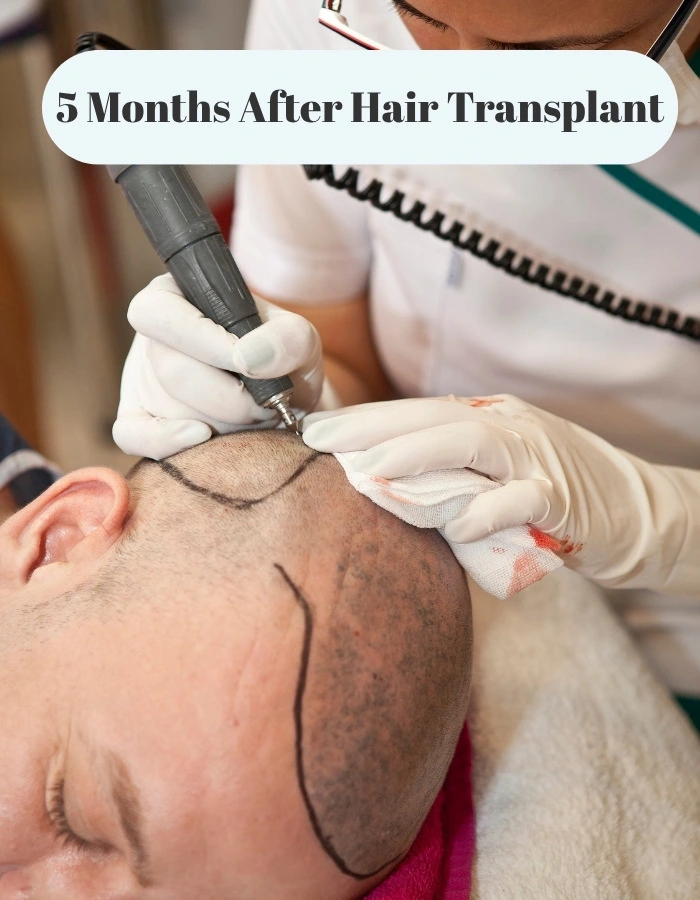
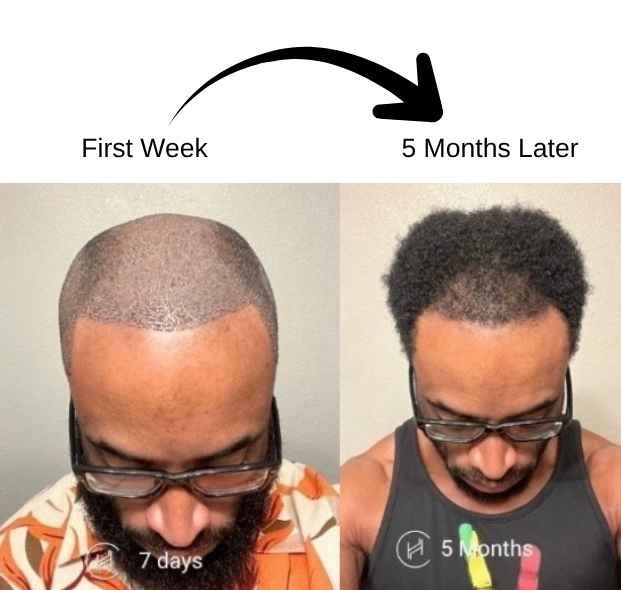
If you are in the 5th month of your recovery, the ugly duckling phase must be over. Five months after hair transplant, while the hair begins to grow slowly, it is not yet thick enough. Nevertheless, for most people, the fifth month after a hair transplant is a turning point. As the hair grows thicker, the bald patches are fully covered. Although it may not yet be at the ideal density, the baldness is finally gone.
Does the popping phase begin at 5 months?
To understand month five, you need to understand the concept of popping. Indeed, the term hair restoration surgeons use to describe the moment a new hair shaft penetrates through the scalp surface. Popping and maturation are the processes that together produce your final result. At month five following transplant, you are in the middle of the popping phase.
- By month 5, approximately 50% of transplanted hairs have penetrated through the scalp. This means that 5 months after hair transplant, you are seeing roughly half of what your transplant will produce. The half you are seeing is still in its earliest, most immature form.
- Those emerging hairs are fine, soft, and grow at varying rates across different scalp zones of your recipient area. It’s not the same as a malfunction. Naturally, hair follicles grow at different rates. They may be in different stages of the hair growth cycle. That’s why when you take a strand of hair in your hand, the strands will be of completely different lengths. Some remain dormant while others begin producing hair shafts. This may create a patchy appearance across transplanted areas until the end of healing.
Biological timeline of hair follicles in the 5th month
Five months after a hair transplant, your hair and scalp will begin to undergo the following biological changes.
- Follicle vascularization is becoming established. The blood supply network that re-established itself around your transplanted follicular units during months two and three is now mature enough. So, it is ready to sustain steady hair production. Each follicle is receiving a consistent supply of oxygen and nutrients.
- Dermal papilla activity is accelerating. The dermal papilla is producing hair matrix cells at an increasing rate. That’s what’s driving the visible growth you’re starting to see.
- Sebaceous gland function is getting back to normal. Each follicular unit contains a sebaceous gland that was temporarily suppressed during the initial hair loss. By month five after hair transplant, these glands are mostly functional again, which is why your scalp may feel less dry and the new hairs have a slightly more natural sheen than they did in months three and four.
- The donor area is fully healed. Any residual numbness, tightness, or sensitivity at the back and sides of the scalp resolves completely between months four and six. By now, the donor zone should look completely normal to anyone who doesn’t know to look for it.
Please also note
Please also note that since this article contains numerous medical terms, if you’re unfamiliar with any of them, you can look them up in our glossary located just below the text.
Go to the medical dictionary →
The healing of the crown area will take time
The crown area, in particular, follows a different course than the hairline and temples. Regrowth in the crown area generally occurs more slowly than along the hairline. The structure of blood flow and the direction of hair growth make regeneration in the crown area more complex. For this reason, hair transplant surgeons often note that it takes longer for density to develop in the crown area.
If you do not see significant changes in your crown area after five months of transplant, this is not a cause for concern; it is simply an anatomical fact.
Perseus Recommends
If your skin is still dry in certain areas five months after your hair transplant, why not try Perseus Nourishing Scalp Care Mesotherapy Serum? While treating subcutaneous acne and itching, it also regulates your skin’s pH balance to help restore an even moisture balance across the entire scalp.
Explore Mesotherapy Serum →How to Care for Your Hair at Month 5 After Hair Transplant
By the fifth month, the overly cautious approach taken during the early stages of the healing process is now a thing of the past. The critical period during the first few weeks, when grafts could dislodge if handled improperly, has long since passed. Your current goal is to create the optimal environment for the follicles to mature. In fact, this means providing support rather than protection.
During the first week, you had to use lukewarm water to wash your hair. You were scared to even touch it, weren’t you? However, by the fifth month, that fear is gone. While using a specialized post-transplant shampoo is still recommended, you can now touch your hair comfortably-just as you did before-and comb it gently.
The best time for scalp stimulation is this month of recovery. Applying mesotherapy serum with a dermaroller, massaging the scalp with your fingertips, massaging with nourishing post-transplant hair oils, and using hair vitamins specially formulated for the post-transplant period… The fifth month is the best time for all of these. Not only has the risk of graft loss greatly decreased, but you’ve also entered the phase where your hair grows the fastest. This period is when you’ll see the fastest results from the care you provide for your transplanted hair.
As your new hair continues to grow at a rate of around 1–2 cm per month, it will also carry on thickening. These immature shafts are more susceptible to UV-induced protein degradation than mature hair. Continue applying SPF 30+ to the scalp when outdoors for extended periods, at least until month six.
What You Should and Should Not See
When hairs first penetrate the scalp between months three and five, they are very fine, transparent, short, and wispy. This is referred to as an “immature” appearance. These immature hairs bear almost no resemblance to the final result they will eventually become.
What is normal:
✓ Fine, wispy hairs visible in at least some sections of the recipient area, more prominently in the hairline and temples than the crown
✓ Uneven density: some patches appearing denser than others, with some areas still showing minimal growth
✓ Hairs that appear lighter in colour than your native hair
✓ A texture that may feel slightly different, sometimes described as wiry and kinky
✓ Some areas still appearing sparse or even bald-looking, particularly the crown
What is not yet present at 5 months after hair transplant and should not be expected:
– Full or final density
– Persistent redness, tenderness, or swelling on transplanted scalp tissue.
– Hair texture matching your native hair
– Uniform growth across all zones
Most patients at leading clinics begin to feel genuinely satisfied and optimistic about their results starting as early as months five to eight after surgery. Month five is the beginning of that window. However, it is not the end of it.
What Other Clinics and Sources Say?
Clinic |
Month 5 Position |
|---|---|
| Wimpole Clinic London, UK |
Most patients start showing early results, a visible improvement in density, by six months, particularly in the hairline and temporal regions, as vellus hairs begin transitioning into terminal hairs. Month five is pre-results. The visible payoff begins at six. |
| Feller Medical New York, USA |
50% of transplanted hairs have surfaced by month five. By six months, approximately 60–70% have penetrated through the scalp. The result at six months is considered around 40–50% matured. Separating "popping" from "maturation" is the clearest clinical model for understanding this stage. |
| Vinci Hair Clinic International |
By month four to five, new growth becomes more noticeable with increasing coverage, though not yet at full density. The hair texture may differ slightly from existing hair. Some patients notice a curlier or finer texture that gradually normalises as the hair matures. |
| Heva Clinic Istanbul, Turkey |
Initial hair growth reaches approximately 20% progress in the fifth month. The biggest improvement generally occurs between the fifth and ninth months. Month five is the launchpad for the most significant visual change period in recovery. |
| Trichogenics International |
Month five represents stabilisation, greater cosmetic changes are expected after this point. Photos taken five months after surgery often create confusion when compared online, as images vary widely because patient age, hair-loss pattern, donor-area quality, and technique all affect results. |
What to Avoid at Month 5
- Chemical dyes, bleaches, etc. These are not recommended for at least six to eight months after the procedure. Immature hair follicles do not have the structural strength to withstand the extreme pH levels of chemical dyeing processes. To be honest, even six months is too early for most patients. Doctors do not recommend it before the first year. However, some patients may be eager to dye their hair. In that case, if they are showing rapid growth, doctors recommend choosing a safe, natural dye.
- Heat styling. High heat damages fragile transplanted strands. Air-dry your hair or use a diffuser on the lowest setting. Air-drying is strictly prohibited during the first few weeks, but after 5 months, you can safely use a hair dryer unless there is a specific condition preventing your scalp from healing.
- Harsh peels. The scalp surface around the emerging hair follicles is still sensitive. Avoid peels, AHAs, and BHAs applied directly to the recipient area. You can go without using these products on your transplanted hair for several years. If you need to cleanse your scalp, you can create a sort of DIY hair botox using post-transplant serums and foams. These products, which deeply moisturize and nourish your hair, can remove unwanted debris from the scalp without damaging the grafts.
- Do not compare your progress with others. Personal timelines vary. For example, a patient showing dense growth at five months and another with sparse growth may both reach the same results by twelve months. Progress photos are most meaningful when compared not to other patients, but to your own previous months.
Contact your clinic if you notice:
- No visible growth anywhere in the recipient area by week 20
- Persistent redness, heat, or small red pustules that do not resolve within a week (possible folliculitis)
- Unusual hair shedding from your native (non-transplanted) hair that seems disproportionate
- Any area that looks consistently darker or has an unusual texture compared to surrounding skin
Hair Growth by the Numbers at Month 5
Understanding where you stand quantitatively helps contextualise what you see in the mirror:
| Metric | Month 3 | Month 5 | Month 9 | Month 12 |
|---|---|---|---|---|
| Hairs Surfaced | ~30% | ~50% | ~90–100% | 100% |
| Maturation Level | Very low | Low–moderate | Moderate–high | High–full |
| Visible Cosmetic Benefit | Minimal | Early | Significant | Near-final |
| Crown vs Hairline Gap | Large | Moderate | Narrowing | Closed |
Glossary of medical terms in the text
Follicle Vascularisation
Dermal Papilla Activity
Sebaceous Gland Function
Crown Area
Mesotherapy Serum
Scalp Stimulation
UV-Induced Protein Degradation
Wiry Hair
What Patients Ask
-
Is it normal to have thin, patchy hair at 5 months after hair transplant?
Normal. The newly transplanted hair often appears thin, soft, and uneven in length at month 5. This does not reflect the final result, as hair follicles are still adjusting to their new environment. Patchiness at this stage resolves progressively.
2. My crown has almost no growth at 5 months. Should I be worried?
No need to worry; the crown area takes time to heal. You can find more detailed information under the heading “The healing of the crown area will take time” above.
3. When will I see a real difference in how I look?
If you’re reading this 5 months after your hair transplant, you only have 1 month left. By the 6th month, your hair will be thicker, and its density will continue to increase. Your hair will also gradually regain its normal texture. Although you’ll still have less hair than you will a year after the procedure, the quality of your hair will improve.
4. How do I know if my grafts survived?
According to the International Society of Hair Restoration Surgery (ISHRS), hair transplant success rates reach 90–98% at experienced clinics. If you had your transplant performed by a qualified surgeon and followed post-operative care correctly, the overwhelming probability is that the vast majority of your grafts survived. The thin, patchy appearance at month five is almost always a function of immaturity, not graft loss. A formal assessment by your surgeon at month six will give you a clinical picture.
References
- Oveisi C. The hair growth cycle, telogen effluvium and psychological impact. Hair Ther Transplant. 2024;14:243. doi:10.35248/2167-0951.24.14.243
- Liu D, Xu Q, Meng X, Liu X, Liu J. Status of research on the development and regeneration of hair follicles. Int J Med Sci. 2024;21(1):80–94. doi:10.7150/ijms.88508
- Avram MR, Rogers NE. Hair transplantation. In: StatPearls. Treasure Island, FL: StatPearls Publishing; Updated August 2, 2025.
- Trüeb RM, Rezende HD, Dias MFRG. A comment on the science of hair aging. Int J Trichology. 2018;10(6):245–254. doi:10.4103/ijt.ijt_56_18
- Vañó-Galván S, Camacho F. New treatments for hair loss. Actas Dermosifiliogr. 2017;108(3):221–228. doi:10.1016/j.ad.2016.09.014
Recommended Reading
✦ Month 4 Progress: Month 4 After Hair Transplant — Track the exciting emergence of new hair growth as dormant follicles wake up and density begins to visually transform.
✦ Density Morphing: The 90-Day Reset: Boosting New Hair Density — Three months in is when the real change begins. Find out how to trigger maximum growth during this critical morphing phase.
✦ Growth Journey: Hair Transplant Timeline: Real Before & After Photos — A comprehensive month-by-month visual guide showing how your hair transitions from surgery to full density over a complete 12-month recovery cycle.


Receive offers, product alerts, styling inspiration and more. By signing up, you agree to our Privacy Policy.
- info@perseusstyle.com