No Density 7 Months of Hair Transplant. Is It Normal?
In this article
- 01Typical Results at Month 7
- 02What Happens 7 Months After a Hair Transplant?
- →Final Results by Area at Month 7
- 03Recovery Chart: Months 1 Through 7
- 04Signs of No Improvement After 7 Months
- 05Why No Density Happens After Month 7
- →Biological Changes in the 7th Month
- →Why Is the Crown Still Bald?
- →Is Hair Growth Still Uneven?
- 06FAQs About No Density at Month 7
It’s been half a year since your hair transplant. Now it’s time for the 7-month post-transplant checkup. However, if your hair still isn’t thick after 7 months of post hair transplant, that’s not normal. Ideally, patients’ hair should appear 60 to 70% thicker after about 210 days. While this percentage may remain around 45–50% in some patients, a complete lack of thickness could be a sign of a hair transplant gone wrong.
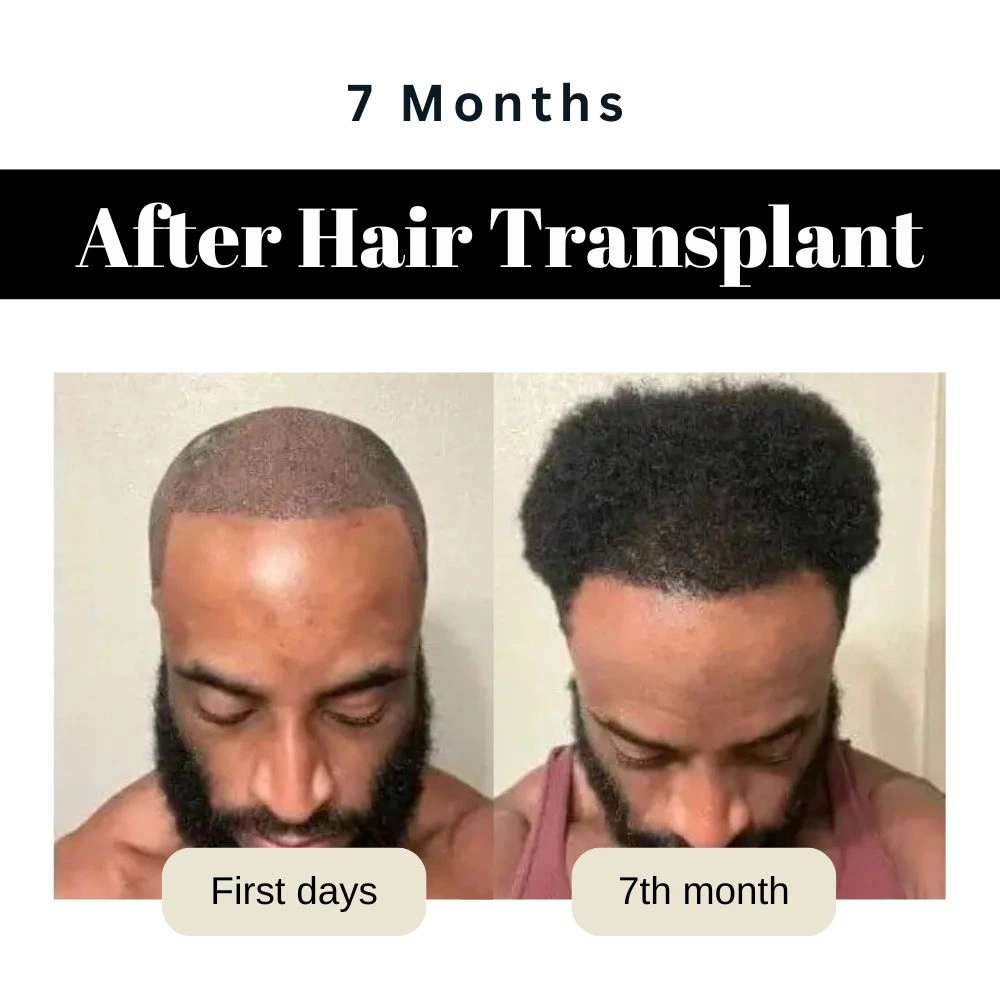
What are the typical hair transplant results by month 7?
If it’s been about 7 months since your hair transplant and your hair still isn’t the way you want it to be, there’s definitely a problem.
By the seventh month, all the hair grafts that survived have taken root and are finally growing. From now on, you just need to wait for these hairs to get thicker. The roots are in an active growing phase, meaning they are growing steadily for the first time since your surgery.
The hair strands are much thicker and stronger than hair in months four and months five after surgery. Your hairline is looking more natural and defined, and the coverage in the transplanted area is much better now.
It is completely normal if the crown area is still growing slower than the rest.
Right now, you have about 60% to 70% of your final hair density. However, the hair strands are not at their full thickness yet. Indeed, they are only about half as thick as they will be. Because the hairs are still thin, your head might look a bit less full in the mirror. As the strands get thicker over the next few months, you will get that full, dense look.
What Happens 7 Months After a Hair Transplant?
By the seventh month, your transplanted hair follicles enter the active growth phase, meaning they are finally growing steadily and consistently.
At this stage, you can expect:
- Thicker Strands: The new hair becomes noticeably stronger and thicker than the weak, baby-like hairs of earlier months.
- A Defined Hairline: Your front line frames your face much more naturally.
- Better Coverage: The empty spaces in the transplanted areas fill in significantly.
Most patients see about 60% to 70% of their final results at this point. Just keep in mind that exact progress varies from person to person depending on your genetics, health, and donor hair quality.
Final results by area at the 7th month
- The frontal line is the area that will show the fastest progress. Since this is the area we notice most easily in the mirror, changes to the hairline should be so noticeable that they might even surprise you. By the 7th month after the hair transplant, the hairline should be completely defined and natural-looking. There should be no visible signs of the surgery, and your hair should frame your face.
- The temples now look similar. Up until the 4th or even 5th month after a hair transplant, your temples may heal differently from one another. In fact, some areas may appear thinner while others look thicker. However, by the 7th month, this difference should have disappeared. The gaps have closed to a large extent. However, since the hair on the temples grows at a more horizontal angle, it may take until the 9th month for it to settle into its natural angle.
- Since the parietal region, the sides, has better blood flow, the hair is nourished more and improves by 80%. Your existing hair blends with your new hair. As the hair strands thicken, the gaps are filled in.
- The vertex (crown) is the area that heals the slowest. By the 7th month, hair growth in the crown area is still at 40–50 percent. The desired density has not yet been achieved. It may take until the 15th to 18th month for the hair in this area to mature.
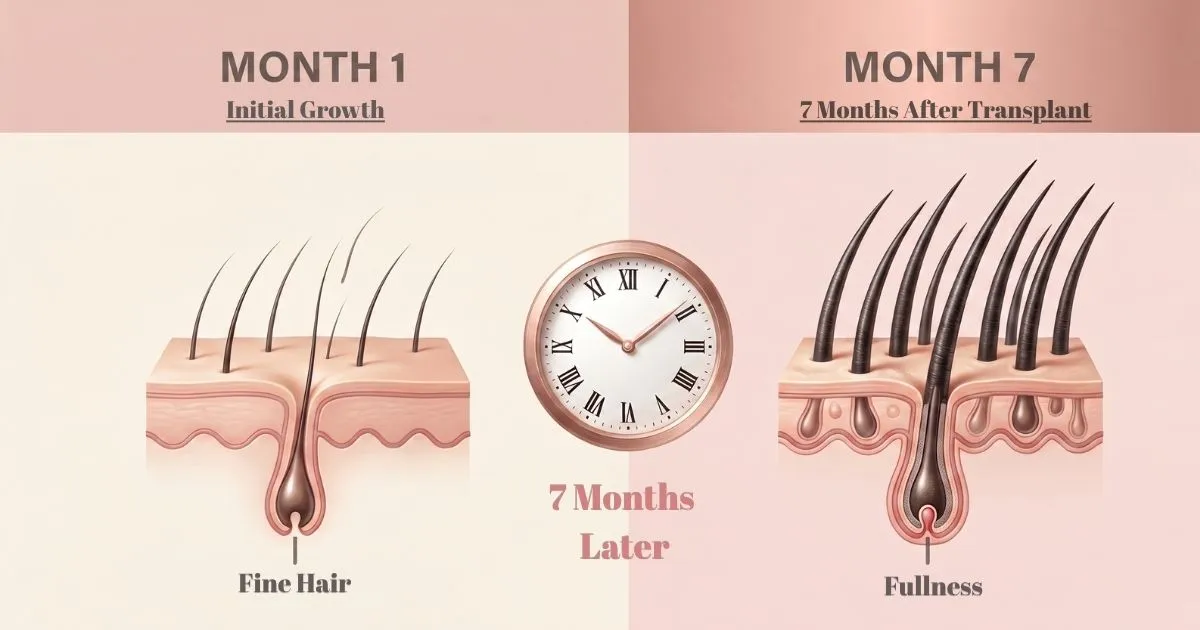
The first 1–2 months after a hair transplant are the shedding phase (shock loss), and this is completely normal. The 7th month is when you’ll see stronger, more consistent growth with better coverage. By the end of this 7-month period, your hair will look completely different.
| What Changes | Month 1 | Month 7 |
|---|---|---|
| Hair Growth | Transplanted hairs shed (shock loss) | Active growth, 60–70% of density |
| Hair Thickness | No new strands present | Strands thickening — roughly half of final diameter |
| Scalp Appearance | Redness, scabbing, visible graft sites | Healed, natural-looking |
| Hairline | Not yet defined | Defined and natural-looking |
| Crown Area | No growth | Still maturing |
| Donor Area | Healing, some numbness | Fully healed. |
| Hair Texture | Too early to assess | Still slightly coarse, softening progressively |
| What to Do | Gentle washing only, no styling | Scalp massage, vitamins, first haircut possible |
Perseus Recommends
Is your hair still not strong and thick enough after 7 months? You can try Perseus Nourishing Scalp Care Mesotherapy Serum. It enhances the volume of your hair strands while nourishing your hair roots with its specialized formula.
Explore Mesotherapy Serum →Signs of No Improvement after 7 Months of Hair Transplant
There are certain symptoms that are not normal and require clinical evaluation:
- No visible growth anywhere in the recipient area.
- Zero crown growth combined with strong hairline growth.
- Persistent folliculitis.
- Visible scarring or unusual texture changes.
- Hair that grew and then shed again after month five.

Why No Density Happens after Month 7
The most visible change in hair transplantation occurs between the 7th and 9th months. This is not due to new hair growing in, but rather to existing hair strands becoming stronger and thicker. The existing hair strands mature and reach their full volume.
If you notice a lack of density in the 7th month after your hair transplant, your hair may still be in the maturation phase. The hair sprouting right now is often fine hair. In the coming 8th and 9th months, these strands will thicken, darken, and blend in with your surrounding hair day by day.
Biological changes in the hair during the 7th month
Here is what happens biologically during the 7th month.
The hair that grows between months 3 and 5 is just weak baby hair. It is thin, clear, and breaks easily. By the seventh month, your body starts turning these weak hairs into real, strong, and permanent strands. During this time, the hair naturally gets darker and grows much thicker.
Also, when hair is transplanted, the tiny oil glands attached to the roots are moved too. These glands need about 7 months to start working normally again. This is exactly why your new hair feels so stiff and dry around month 4. By month 7, these glands mature, giving your hair its natural moisture, softness, and shine back.
Why is the crown area still bald in the 7th month?
The crown (vertex) region of the scalp has a completely different and much weaker vascularization/blood flow pattern compared to the frontal hairline and temples. For this reason, the regeneration of capillaries in this area takes much longer after surgery.
While significant closure is observed in the frontal region by the 6th month, it may take up to 18 months for results in the crown region to fully stabilize. The fact that density in the crown region lags significantly behind that of the front by the 7th month indicates that this area is anatomically supplied with blood more slowly.
Is hair growth still uneven in the 7th month?
Not all hair follicles enter the growth phase on the same day. While some follicles emerge and thicken in the 3rd month, others are just beginning to surface in the 7th month. This variation in growth temporarily creates localized gaps and a patchy appearance. This appearance becomes more even in the nape, around the ears, and on the sides, but may still appear uneven in the frontal area and at the crown, where healing is still ongoing.
Helpful FAQs About No Density 7 Months After a Hair Transplant
Is it normal if my hair still looks sparse at 7 months?
Not rare. Many people still feel they have low density around 7 to 9 months after a hair transplant. It’s often part of a normal recovery, not a failure. Many follicles are still maturing and will fill in over time.
What if there’s no growth at all by 7-8 months?
If you feel that there is no significant growth seven months post-procedure, please send photos of your scalp from various angles to your post-op care team. They will consult with your doctor regarding your procedure, review the details, and advise you on the next steps. If there are any issues with your hair transplant, you may need a follow-up consultation, additional medications, or supportive treatments such as SMP, PRP, or i-PRF.
Is 7 months enough to judge hair transplant results?
The hair restoration process is far from complete. So, 7 months of hair transplant is not enough to judge. At 7 months of hair transplant recovery, most patients have only achieved about 60% to 70% of their total expected growth. Over the next few months, hair will continue to break through the scalp, while the existing ones will thicken, mature, and improve in texture. Final density and full coverage typically become visible between 12 to 15 months post-op.
References
-
Romera de Blas C, Vega Díez D, Ricart Vayá JM, Gómez Zubiaur A. Complications in follicular unit excision hair transplantation: current evidence and practical approaches. Front Med (Lausanne). 2026;13:1750989. doi:10.3389/fmed.2026.1750989
-
Doctor Gary Linkov. 7 Months Post Hair Transplant | Hair Surgeon Reacts. YouTube. September 29, 2025. Accessed July 13, 2026.
-
HEVA. 5000 Grafts Later… Reemo Styles Shares His Hair Transplant Experience in Turkey @thestylesfamilia. YouTube. July 8, 2026. Accessed July 13, 2026.
-
Stroulger R. Hair transplant journey update. TikTok. June 20, 2023. Accessed July 13, 2026.
Recommended Reading
✦ Halfway Milestone: 6 Months After Hair Transplant — Celebrate the halfway point of your recovery as approximately 50-60% of your final density becomes visible with stronger, thicker hair strands.
✦ Pre-Op Diagnostics: Blood Tests Before Hair Transplant — Understand why essential blood panels (CBC, infectious disease screenings, and hormone levels) are mandatory for a safe and successful procedure.
✦ Medication & Shedding: Does Ozempic Cause Hair Loss? — Explore the link between rapid weight loss drugs like semaglutide and telogen effluvium, and learn how to protect your hair density.


Receive offers, product alerts, styling inspiration and more. By signing up, you agree to our Privacy Policy.
- info@perseusstyle.com