Exosome after hair transplant in 2026
Written by Perseus Editorial Team
Last Update: August, 2026
Exosome after hair transplant can contribute to hair transplant results and accelerate healing. So what exactly are exosomes? Exosomes are very small reparative carriers secreted by cells in the body to communicate with each other. They contain powerful growth signals that stimulate hair follicles and renew tissue.
What is exosome after hair transplant?
Exosome hair treatment is the most innovative and biotechnological method developed in recent years to combat hair loss. It is considered a step up from traditional methods such as PRP, iPRF, hair botox, or mesotherapy.
After hair transplantation, exosome therapy aims to:
- improve the nourishment of hair follicles,
- accelerate the healing process,
- promote stronger and thicker hair growth.
What’s in the exosome solution?
Exosome serums contain biological signals that trigger regeneration, such as growth factors, proteins, lipids, mRNA, and microRNA. Stem cell-derived exosomes, in particular, are used to initiate the self-repair process of damaged tissue and increase cellular activity.
Step-by-step application of exosome after hair transplant
The steps of exosome therapy for hair loss are as follows.
- We begin with the preparation process. The application is performed in a clinical setting. Exosomes are available in the form of purified, frozen, or sterilized ready-to-use vials in a laboratory setting. The application must be performed by a doctor.
- The injection step is the second step. An anesthetic cream is applied beforehand. Then, exosome injections are applied to the areas of hair loss on the scalp using very fine needles (using the micro-needling or mesotherapy method). The procedure takes approximately 15 to 30 minutes. You may feel very little pain, but it is generally considered painless.
Who can receive exosome for hair growth?
Exosomes in aesthetics are preferred by patients with androgenetic alopecia who are troubled by hair loss. Individuals who do not have an inflammatory skin disease, are not pregnant or suspected of being pregnant, and do not have a serious illness can receive this treatment. There is no age limit for individuals to receive this treatment as long as they are adults.
Is it possible to get exosomes after hair restoration?
It is possible to receive exosome therapy after hair transplant operations. It can increase the healing process and the likelihood of the transplanted grafts taking root in the skin. Exosomes can send repair and growth signals to cells after the transplantation. This accelerates the healing of the donor area in the initial stage, and then the transplanted strands adapt to the skin more quickly. The most common question regarding the relationship between exosome hair therapy and hair transplantation is how many days after hair transplantation should exosome therapy begin.
When should one begin exosome hair treatment after hair transplantation?
Many clinics can perform the first session soon after the operation or within the first forty-eight hours. This helps reduce first signs of transplant like redness and swelling. If treatment is not started right away, it can begin after the scab formation is complete (usually starting from the two-week mark). If you ask about the ideal schedule, support sessions performed 1, 3, and 6 months after the operation generally promote thicker hair regeneration.
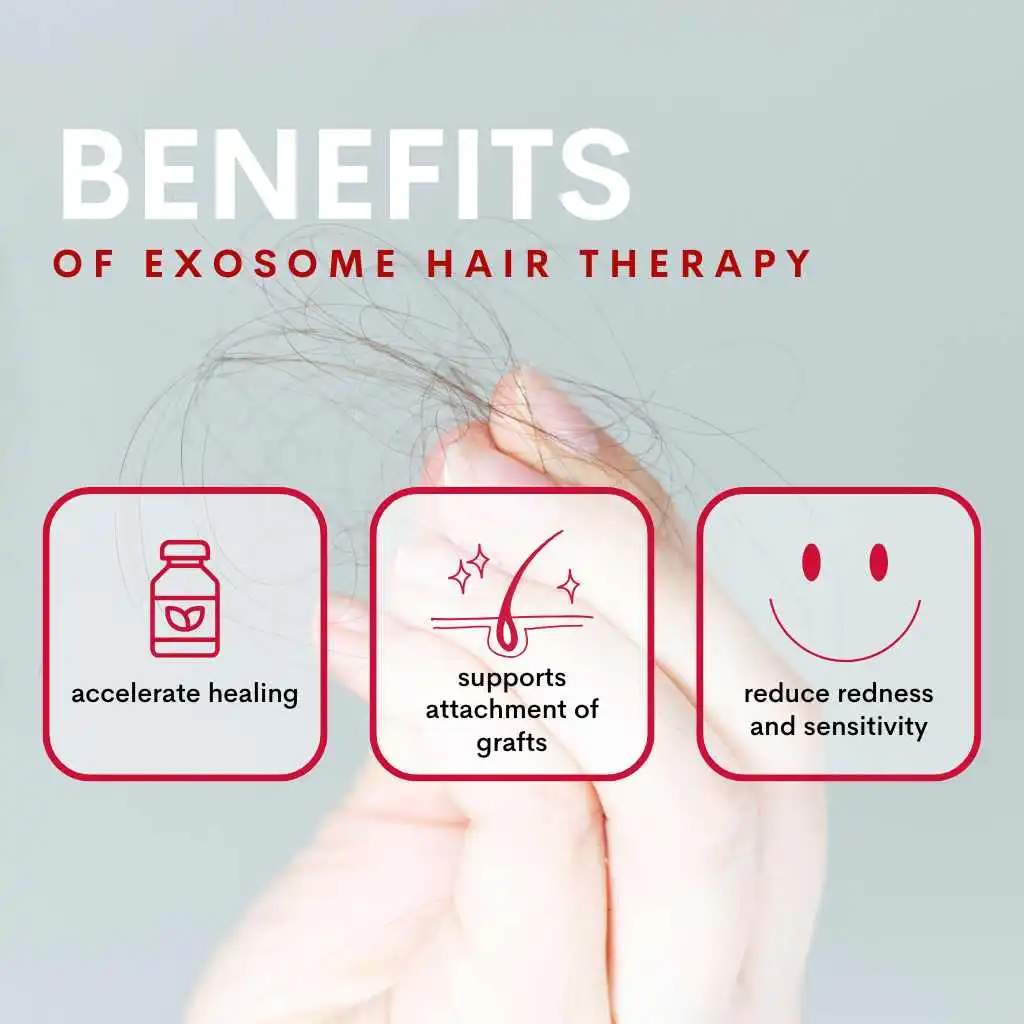
What are the benefits of exosome after hair transplant therapy?
Exosome application:
✔ Can accelerate healing after hair transplantation
✔Can help reduce redness and sensitivity more quickly
✔ Supports stronger attachment of transplanted grafts
✔ Can make the shock loss process milder
✔ Contributes to thicker and healthier new hair growth
Recovery after Exosome hair therapy
You can return to your daily routine immediately after the exosome procedure. There is no harm in doing so. Since it is a very short and almost painless procedure, it does not require a long recovery period. We only recommend that you avoid touching your hair too much for the first 2 weeks after the injections to avoid the risk of infection. It is advisable to wait at least one month before dyeing your hair or subjecting it to any chemical treatments. It is also not recommended to use too many products on your scalp. Whenever possible, choose post-op products and chemical-free shampoos and creams.
Post-hair transplant products after exosome hair therapy
After the first 2 weeks of the exosome hair procedure: Immediately after the exosome procedure, moisturizing and gentle cleansing are necessary to aid the healing process. For this purpose, you can use a panthenol spray or foam to soften dry skin. Perseus panthenol foam can serve this purpose perfectly. Alternatively, a medical shampoo with a mild formula can also be used. It can be effective in gently cleansing any skin crusts that may form after treatment. At the same time, your doctor may prescribe antibiotic creams or ointments to prevent infection during the first few days.
PRP or Exosome: Which one is better after hair restorations?
Indeed, treatments such as plated exosomes are similar to PRP. Plated exosomes are vesicles obtained from human platelets. They are similar to platelet-rich plasma. However, there is a significant difference between classic exosome treatment for hair and PRP.
Exosomes are produced from stem cells in a laboratory setting. They contain hundreds of times more growth factors than PRP. They have a standard and high-concentration content.
- So, while we wait 10 days for PRP, why can exosomes be applied just 2 days after hair transplantation?
PRP contains live platelets obtained from your blood. These cells need to be activated at the injection site to release growth factors. Since tissue is highly swollen and damaged immediately after a transplant, PRP injections can apply pressure to fresh channels and hair graft units.
Exosomes, on the other hand, are not live cells; they are microscopic vesicles secreted by cells. Because they are much smaller, they penetrate tissue faster without causing trauma. As they are purified in a laboratory environment or via apheresis, they do not trigger an immune response on their own, and therefore have a high capacity to soothe the tissue immediately after the transplant.
FAQs about exosomes
Does exosome therapy improve graft survival?
Yes, by increasing blood flow and reducing inflammation in the recipient area, exosomes help to supply more oxygen and nutrients to newly transplanted grafts, thereby supporting stronger attachment.
Can exosomes reduce shock loss after a hair transplant?
Exosome therapy may help minimize shock loss by strengthening the transplanted follicles and improving the healing environment of the scalp. However, it cannot completely prevent shock loss.
How many sessions are needed after a hair transplant?
The number of sessions depends on the treatment plan and the patient’s scalp condition, but many clinics recommend 1 to 4 sessions for the best exosome hair therapy results.
When will I see results after exosome treatment after hair restoration?
After the hair restoration procedure, following the application of exosome therapy, the first signs of improvement in scalp healing are usually noticeable within 1-2 weeks.
Visible hair growth effects, such as thickening of the hair shaft, increased density, or faster growth of transplanted hair, typically appear approximately 3-4 months after treatment. Full benefit is usually seen within 6-9 months, when the transplanted follicles are fully stabilized and actively growing.
Exosome therapy primarily supports grafts and accelerates the growth cycle, so timing varies among patients.
References
- Lee E, Choi MS, Cho BS, Won YJ, Lee JH, Kim SR, et al. The efficacy of adipose stem cell-derived exosomes in hair regeneration based on a preclinical and clinical study. International Journal of Dermatology. 2024;63(9):1212-1220.
Ozer E, Akin O, Tasli PN, Ersan M. Effectiveness of exosome treatment in androgenetic alopecia: Outcomes of a prospective study. Aesthetic Plast Surg. 2024;48(21):4262-4271. doi:10.1007/s00266-024-04332-3
Queen D, Avram MR. Exosomes for treating hair loss: A review of clinical studies. Dermatol Surg. 2025;51(4):409-415.
Bento EB, Matos C, Ribeiro Junior HL. Successful treatment of hair loss and restoration of natural hair color in patient with alopecia areata due to psychological disorder using exosomes: Case report with 6-month follow-up. Cosmetics. 2025;12(3):97.
Gupta AK, Carviel J. A review of exosomes in the treatment of androgenetic alopecia. J Drugs Dermatol. 2021;20(12):1290-1296. doi:10.36849/JDD.6180
Recommended Reading
✦ DHT Blocker Integration: Finasteride After Hair Transplant — Learn when and how to safely start or resume finasteride to protect your native hair and secure long-term transplant density.
✦ Soothing Botanical Care: Aloe Vera Gel After Hair Transplant — Discover how natural aloe vera helps calm post-op redness, soothe irritation, and support early scalp healing.
✦ Gentle Scalp Protection: Paraben-Free Shampoo After Hair Transplant — Understand why dermatologists recommend paraben-free and sulfate-free formulas to safeguard fragile new grafts and maintain optimal scalp pH.


Receive offers, product alerts, styling inspiration and more. By signing up, you agree to our Privacy Policy.
- info@perseusstyle.com